Chris Curl,
Editor
July 30, 2026
China is quietly proving that open, competitive AI ecosystems move faster than tightly controlled ones.
On paper, the United States should be the uncontested leader in AI. It has the deepest capital markets, the strongest chip supply chain, and a dense network of research labs and startups.
Yet in practice, a strange paradox is emerging: some of the most aggressive real‑world experimentation is now happening elsewhere (particularly in China’s open‑source and quasi‑open ecosystems) while a handful of U.S. firms work to turn AI into a vertically controlled utility.
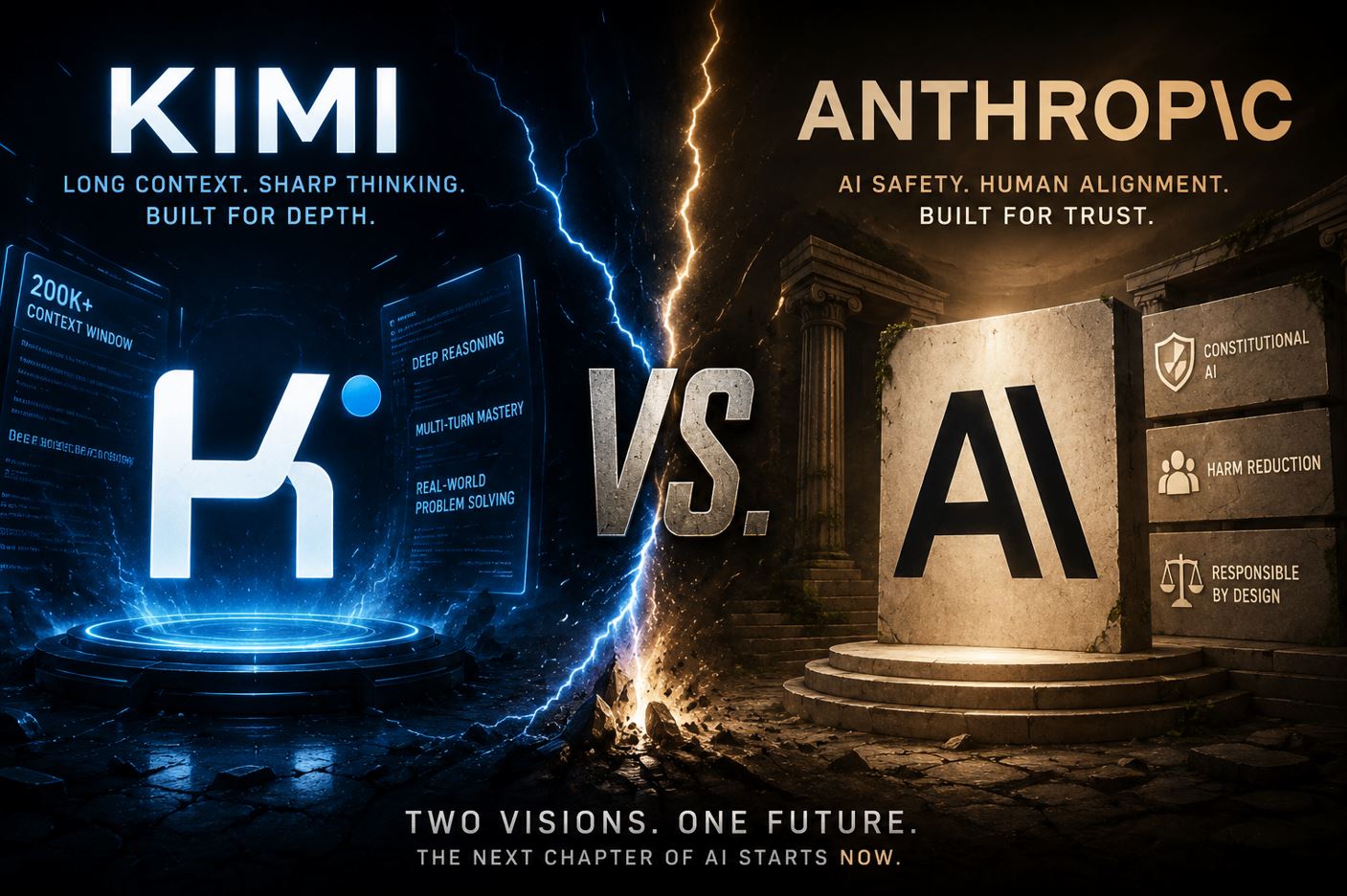
Models like Kimi are a good example of what happens when the default stance is “ship and iterate” rather than “gate and restrict.” Chinese labs are releasing large models rapidly, openly benchmarking them, and encouraging third‑party developers to build on top. The code may not always be fully open in the Western sense, but the direction is clear: more access, faster forks, and a swarm of small companies trying weird, domain‑specific things without having to beg a single gatekeeper for permission.
Contrast that with the trajectory of several marquee U.S. players, including Anthropic.
Anthropic’s entire brand is built around being the “safe,” highly aligned AI company. Its pitch to regulators and enterprise buyers is simple: this technology is too powerful to be left to chaos, so it should be concentrated in the hands of a few responsible actors who set the rules. In practice, that has meant highly centralized APIs, heavy‑handed content controls, and lobbying for regulatory frameworks that just happen—purely by coincidence—to map neatly onto the capabilities and compliance infrastructure of the largest incumbents.
It is a bid for a stranglehold of the AI industry.
When a small set of companies can unilaterally decide which applications are allowed, which use cases are “acceptable,” and which competitors get rate‑limited or de‑platformed, you do not get a safer ecosystem. You get a slower, more brittle one that privileges political risk management over technical experimentation. You also get a quiet moat: if the law says only a few certified labs can operate frontier models, everyone else becomes a customer instead of a rival.
In the short term, that might look comforting to U.S. policymakers and large enterprises. They get a single throat to choke, a set of vendors who speak fluent Washington-ese, and the illusion that AI risk can be outsourced to a handful of “responsible” firms. In the long term, it is a growth tax on the entire American economy.
Because while the United States is busy turning AI into a regulated utility, others are treating it like an open‑ended toolkit.
Chinese models like Kimi are already being embedded into countless niche workflows (industrial design assistants, local commerce tools, education platforms, logistics optimizers) that may never show up in Western headlines but matter enormously in aggregate. They are good enough to be useful, cheap enough to be everywhere, and open enough that thousands of developers can adapt them without waiting for a corporate ethics committee to weigh in.
That is how compounding advantage actually works. It does not come from having the single “best” model frozen inside one company’s servers. It comes from having millions of experiments running at the edge: small teams pushing the tech into weird corners of the real world, discovering what breaks, and feeding those lessons back into the next generation.
A stranglehold model kills that.
If every serious U.S. startup has to route its core product through one of a few proprietary APIs, innovation collapses into a narrow corridor. Pricing power sits with the model vendor, not the application builder. Whole categories of ideas will never be attempted because they are too controversial, too small, or too misaligned with the incumbent’s business plan. Over time, that means U.S. companies ship slower, experiment less, and cede ground to ecosystems that are messy but energetic.
The irony is that American firms did this to themselves once already.
The early internet exploded because protocols were open and permissionless. Anyone could build a website, start an email list, or deploy a new app without filing a form with a central gatekeeper. That chaos produced spam, fraud, and bubbles… but it also produced Amazon, Google, and the modern software industry.
Imagine if, in 1996, the U.S. government had decided that HTTP and TCP/IP were too dangerous for ordinary people and that only three licensed “Internet Providers” could run apps on top of them. That is roughly the model being proposed for frontier AI today.
Meanwhile, China is, in its own way, replaying the early web: a mixture of state constraints and commercial free‑for‑all that still nets out to “ship more, ship faster” at the edge. Kimi and its peers are not constrained by the same Western content debates. They do not need to harmonize their policies with every Western regulator. They just need to be good enough and cheap enough to eat practical work.
Over a decade, that difference in posture compounds into a gap in capability.
For U.S. companies, the risk is clear: they get stuck on the wrong side of that gap. They become tenants in someone else’s AI stack, paying rent to a small cartel of model providers, begging for higher rate limits, and constantly redesigning products to fit within ever‑shifting policy boundaries. Their margins get squeezed, their speed slows, and their ability to differentiate erodes.
So what does a better path look like?
- Open, competitive access to strong base models—whether via open‑source weights, truly neutral infrastructure, or at least a large, diverse field of vendors.
- Regulatory focus on outcomes (abuse, fraud, real‑world harm) rather than cartelizing who is allowed to build.
- A cultural default toward experimentation, with guardrails that are transparent and contestable, not buried in a model provider’s terms of service.
In other words: more Kimi‑style dynamism, less Anthropic‑style paternalism.
This is exactly the kind of structural shift that Digital Dispatch is built to track.
Dispatch does not just look at who has the flashiest demo. It looks at how power is being arranged: which countries are quietly embracing open models, which corporations are trying to lock down the stack, and where developers still have the freedom to build without asking for permission. It follows the practical consequences of that divergence: for startups, for public markets, for hard‑money systems like Bitcoin riding underneath it all.
If you want to understand where the next decade of AI will actually be decided, you cannot just watch the big American labs and their press releases. You have to watch the places where people are still allowed to move fast, break things, and fork the code.
Digital Dispatch is where those signals get pulled together so you are not stuck on the wrong side of someone else’s stranglehold when the real compounding growth starts.
Click here to get started.
Keep coming back,

Chris Curl
Editor, Bizarro World