Nick Hodge,
Publisher
July 14, 2026
Space stocks have gone vertical over the past few years.
The market has clearly decided something important: Space is no longer science fiction.
It’s infrastructure.
And once Wall Street starts treating a sector like infrastructure, valuations can get stupid in a hurry.
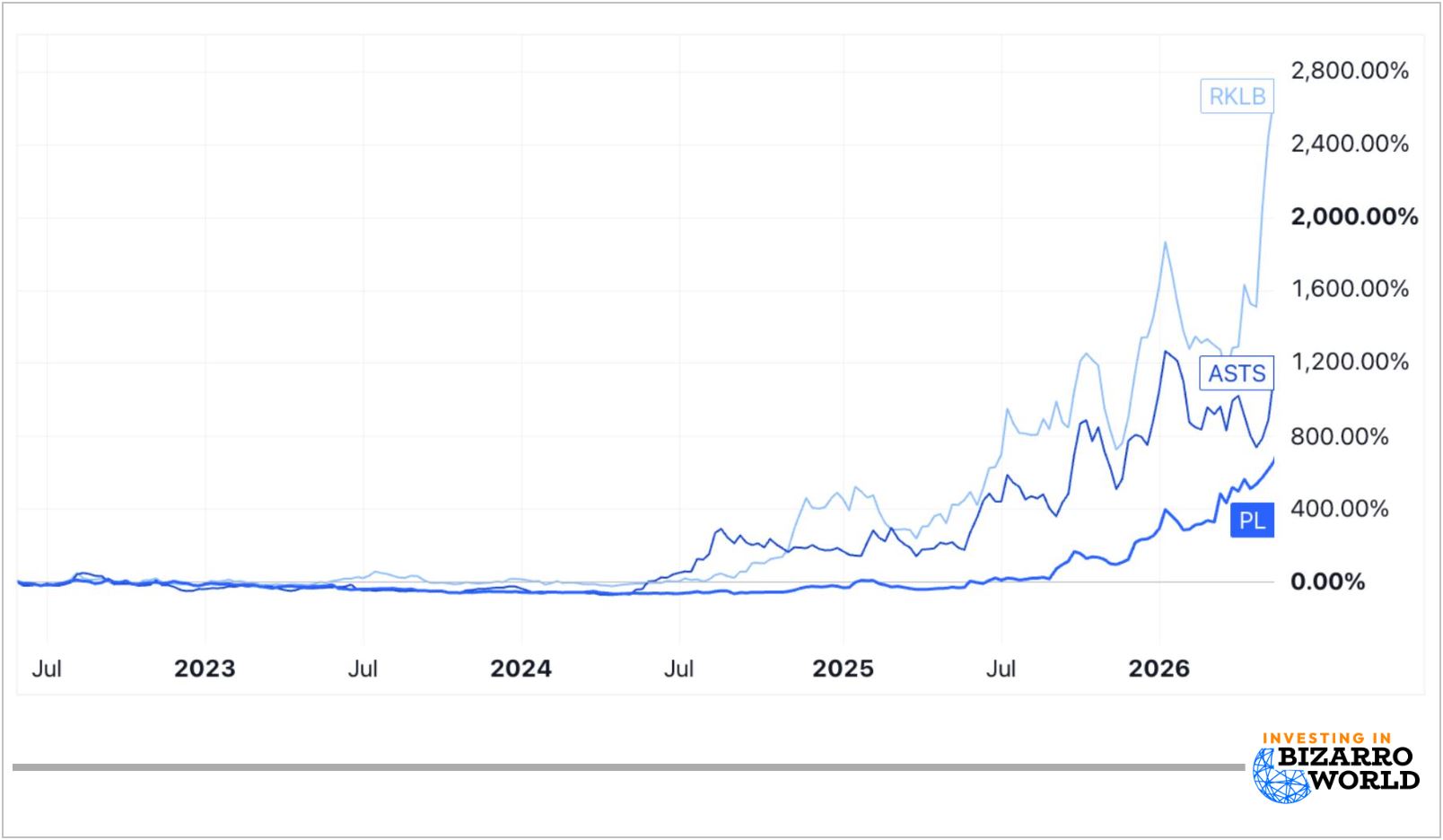
Just look at what has happened over the past few years.
Rocket Lab has surged more than 2,400%.
AST SpaceMobile went up more than 1,200%.
Planet Labs delivered over 600% upside.
That’s not because every space company is suddenly profitable.
It’s not because every business model is proven. And it’s definitely not because the sector is low risk.
It’s because investors are waking up to the idea that space is becoming a real economy.
Launch. Satellites. Communications. In-orbit servicing. Cargo movement. Space stations.
The market is starting to price the picks and shovels of the next industrial frontier.
And the biggest money is no longer being made by waiting for these companies to become obvious.
It is being made by getting positioned before the crowd understands what it is looking at.
The Financial Times recently pointed out something that should get every speculative investor’s attention.
Rocket Lab now carries a market capitalization of about $57 billion.
That makes it roughly one-fortieth the size of SpaceX.
Read that again.
A $57 billion company is the “small” one.
And according to the same FT piece, Rocket Lab’s valuation is about 50 times forward revenue.
That is the kind of multiple the market reserves for scarce, strategic, high-growth infrastructure.
It is also the kind of multiple that can turn early shareholders into very wealthy people.
But here is where it gets even more interesting.
Rocket Lab just agreed to buy Iridium for about $8 billion.
That deal isn't just about satellites. It’s about vertical integration.
SpaceX is already doing this.
It does not just launch rockets. It has Starlink. It has communications. It has the launch platform, the customer relationship, the recurring revenue stream, and the industrial base.
Rocket Lab is trying to move in the same direction.
Launch is just one piece.
The business around launch is the bigger prize.
The FT called this the return of vertical integration.
Tech founders do not always use that phrase. They prefer “full stack” or “end to end.”
But the concept is the same.
Own more of the chain. Control more of the customer. Capture more of the economics.
And in space, that means the big players will not stop at rockets.
They will want the infrastructure layer that makes space useful after the rocket gets there.
That is the part I want you to focus on.
Because while everyone is staring at SpaceX, Rocket Lab, AST SpaceMobile, Planet Labs, and the other public space names that have already run…
We have access to a tiny pre-IPO company trying to build one of the missing pieces of the space economy.
The name, terms, ticker path, deal documents, and access to the pre-IPO are reserved for members of Private Placement Intel.
This company is not trying to compete with SpaceX.
It’s not trying to build a better rocket. It’s not trying to become the next Starlink.
Instead, it’s focused on what happens after launch.
Because getting to space is only step one.
Once cargo, satellites, payloads, sensors, robotics, defense hardware, materials, or station components are up there, someone has to move them, service them, test them, validate them, connect them, and eventually transport them between platforms.
Those operations are called ‘in-space logistics.’
Think of it as the trucking, towing, servicing, and warehousing layer for orbit.
That layer barely exists today.
But if the space economy is really going where Wall Street thinks it is going, it has to exist.
And that is why this tiny deal is so interesting.
The company is being financed at roughly C$25 million, or about US$17 million.
That is not a typo.
Not $17 billion. Not $1.7 billion. About $17 million.
Rocket Lab is valued around $57 billion.
That makes Rocket Lab more than 3,000 times larger than the company we are currently helping members access.
Impulse Space, a private in-space logistics company, recently raised money at a reported $4.2 billion valuation.
That is nearly 250 times higher than this deal.
And SpaceX?
Depending on which Wall Street analyst you ask, SpaceX is either already one of the most valuable companies in the world or on its way to becoming something absurdly larger.
Raymond James reportedly put an $800 price target on SpaceX after its IPO.
That target implies a market capitalization north of $10 trillion.
That would be more than Apple and Nvidia combined.
More than 10 Berkshire Hathaways.
Almost too big to comprehend.
And whether you believe that number or not, the point is obvious:
Wall Street is now willing to pay enormous valuations for companies that can control critical pieces of the space infrastructure stack.
Most people didn’t get SpaceX pre-IPO.
Most people did not get Rocket Lab before the move.
Most people did not buy AST SpaceMobile before the market decided to care.
At Private Placement Intel, we are trying to get positioned before the public market fully prices the opportunity.
This company has a near-term business built around helping customers validate hardware before it goes fully to orbit.
Before a new radiation shield, sensor, battery, solar array, robotics component, communications system, defense payload, or university experiment gets sent into space, someone has to test it.
Someone has to integrate it.
Someone has to fly it in a space-like environment. Someone has to collect the data. Someone has to help the customer reduce technical risk before committing to a full orbital mission.
That’s what this company does.
And it’s exactly the kind of capability larger space companies may eventually want to own.
If Rocket Lab is buying Iridium to become more vertically integrated…
If SpaceX is using Starlink to turn launch dominance into recurring communications revenue…
If Wall Street is rewarding “full-stack” space infrastructure…
Then ask yourself a simple question:
What happens when the large space companies decide they need logistics, servicing, validation, and cargo movement in orbit?
They can build it. Or they can buy it.
And right now, before it goes public, Private Placement Intel members have a chance to participate in the financing.
The current deal is being done at C$0.80 per unit.
Each unit includes one share and one-half warrant.
Each full warrant is exercisable at C$1.50 for two years.
The expected public listing path is already underway.
The valuation is tiny compared with the space companies Wall Street is already rewarding.
And the only way to get access to the pre-IPO financing is to become a member of Private Placement Intel.
Call it like you see it,

Nick Hodge
Publisher, Bizarro World