Gerardo Del Real,
Editor
Oct. 20, 2026
Big Tech is funding decades of nuclear power. Washington may soon compete for every pound America mines.
Amazon and Google just committed billions of dollars to keep American nuclear reactors running longer and producing more electricity.
But the most important new buyer may be the one receiving the least attention.
The National Nuclear Security Administration recently asked the uranium industry about supplying four million pounds of U.S.-origin uranium annually from 2030 through 2040.
That works out to 40 million pounds over 10 years.
For context, America is expected to produce roughly four million pounds of uranium this year.
Washington could be preparing to absorb the equivalent of the country’s entire current annual production — every year for a decade.
Those pounds would support national defense programs, including naval nuclear propulsion and tritium production. Imported material generally cannot satisfy the requirement because the uranium must be mined domestically and remain free of foreign-use restrictions.
Meanwhile, America’s commercial nuclear reactors consume approximately 49 million pounds annually.

Do the math.
A new government buyer could claim every pound currently mined in the United States while the existing reactor fleet continues searching for nearly 50 million pounds of fuel each year.
This is exactly what a Convergence Event looks like.
Big Tech Is Writing the Checks
The demand story is accelerating well beyond Washington.
Amazon recently signed a 20-year power agreement with Constellation Energy that will support more than $3 billion of investment at Maryland’s Calvert Cliffs nuclear plant.
The agreement covers 690 megawatts of power and will help fund a 190-megawatt increase in the plant’s generating capacity.
Calvert Cliffs began operating in the 1970s. Amazon’s commitment will provide the revenue certainty needed to modernize the plant, pursue another 20-year license extension, and explore adding advanced reactors at the site.
This structure also addresses one of the biggest criticisms surrounding data centers.
Rather than simply consuming electricity already available to homes and businesses, Amazon is helping pay for additional generating capacity that will flow onto the regional grid.
Google followed with an even larger deal.
Its 20-year agreement with Constellation will fund more than $4.3 billion of improvements across 11 reactors in Illinois, Pennsylvania, and New Jersey.
Those upgrades are expected to create 890 megawatts of additional nuclear capacity — roughly equivalent to building another large reactor.
A separate 15-year supply agreement covers another 2,700 megawatts of existing generation.
Between Amazon and Google, more than $7 billion is now headed toward America’s operating nuclear fleet, supporting 1,080 megawatts of new capacity.
Microsoft is funding the restart of Three Mile Island.
Google is also supporting the proposed restart of Iowa’s Duane Arnold plant and has agreements with Kairos Power for a fleet of advanced reactors.
Meta has signed its own 20-year nuclear agreement with Vistra.
For decades, regulated utilities were effectively the only major buyers in the nuclear market. Today, the richest technology companies on Earth are signing 15- and 20-year contracts because artificial intelligence cannot run on intermittent electricity.
Big Tech needs dependable power around the clock.
Nuclear is increasingly the preferred solution.
New Reactors Are Moving Forward
Existing plants offer the fastest route to additional electricity, but new reactor projects are advancing as well.
Blue Energy recently submitted the first portion of its construction permit application for a new gas-to-nuclear facility at the Port of Victoria, Texas.
Its plan begins with natural-gas turbines and shared infrastructure before adding a GE Vernova Hitachi BWRX-300 small modular reactor.
Blue Energy has raised more than $400 million and expects to make a final investment decision in 2027.
The Nuclear Regulatory Commission also approved TVA’s construction permit for a 300-megawatt BWRX-300 at Clinch River, Tennessee.
The NRC completed its review in 14 months — four months ahead of schedule — clearing the way for what could become America’s first commercial small modular reactor.
TVA will still require a separate operating license before loading fuel, while Blue Energy remains early in the permitting process. Those distinctions matter.
The direction matters even more.
Capital is being committed. Regulatory timelines are shrinking. Existing reactors are being upgraded, and new designs are entering the construction pipeline.
Every additional megawatt eventually requires more uranium.
The Fuel Market Is Warning Us
Uranium’s long-term contract price reached an all-time high of $96 per pound in August.
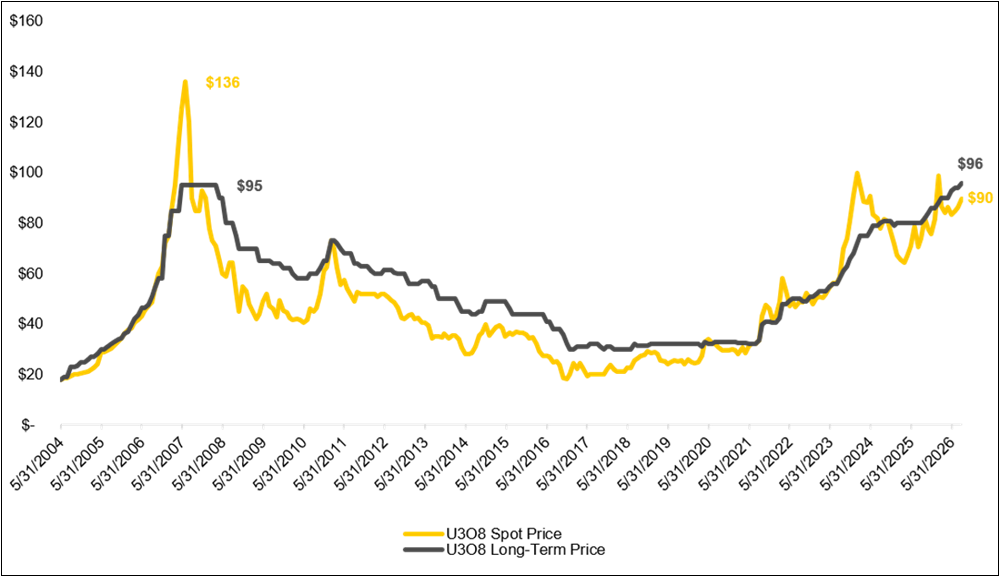
That figure matters more than the daily spot quote because most uranium is sold through multiyear agreements between miners and utilities.
Rising term prices, contract floors, and ceilings indicate that utilities are accepting increasingly producer-friendly economics to secure future deliveries.
The contracting pressure is only beginning.
According to Sprott, maximum U.S. utility coverage falls from approximately 60% in 2030 to just 9% by 2033. European coverage declines from 100% to 36% by 2034.
Utilities cannot wait until those years arrive.
Uranium must be contracted, mined, converted, enriched, fabricated into fuel, and delivered long before it enters a reactor.
Developing a new uranium mine can require 15 to 20 years. Much of the recent production growth has come from restarting previously operating mines, while the next supply wave will depend increasingly on more expensive and difficult greenfield projects.
Since 2020, uranium prices have roughly tripled. Global mine production has risen by only about 50%, despite those much stronger prices.
Now the industry must supply life extensions, reactor restarts, uprates, small modular reactors, international nuclear expansion, and a potential 40-million-pound order from the U.S. government.
The buyers are multiplying faster than the mines.
The Third Convergence Event
The setup now contains all three elements I look for in a historic resource cycle:
- A supply base weakened by decades of underinvestment.
- Government action aimed at securing strategically vital domestic production.
- A powerful new source of demand with enormous financial resources.
During the last major uranium cycle, the underlying commodity climbed from roughly $10 per pound to $136. Several small uranium companies delivered gains measured in the tens of thousands of percent.
Today’s fundamental setup may be even stronger because utilities, governments, military programs, and trillion-dollar technology companies are all competing for the same constrained fuel supply.
I have spent months studying the North American companies positioned to benefit.
My research led me to three investments:
- An American uranium producer already pulling material from the ground;
- A higher-leverage explorer controlling a major uranium land position, and;
- A vehicle that provides direct exposure to physical uranium.
In my presentation, The $10 Trillion Energy Stone, I explain how this Third Convergence Event developed, why the uranium shortage cannot be solved quickly, and how to access my complete report containing the names, ticker symbols, recommended buy ranges, and investment cases for all three opportunities.
Big Tech has committed to decades of nuclear power.
America is preparing to build and upgrade reactors.
Washington may soon compete for every domestic pound the country currently produces.
The new uranium buyer has arrived.
Watch The $10 Trillion Energy Stone presentation now and discover the three uranium investments I’m putting my own money behind.
Let's get it,

Gerardo Del Real
Editor, Bizarro World