Nick Hodge,
Publisher
July 21, 2026
Most investors in the resource space spend a lot of time thinking about the “why.”
Why gold should go higher. Why uranium matters again. Why copper supply is structurally short. Why China’s dominance over critical minerals is a national security problem. Why the Federal Reserve, deficits, debt, money printing, and a weakening dollar continue to push serious capital toward hard assets.
I’ve made those arguments for more than 15 years.
But there is another question that matters just as much.
It’s the “how.”
How do you actually invest in these themes before the crowd shows up?
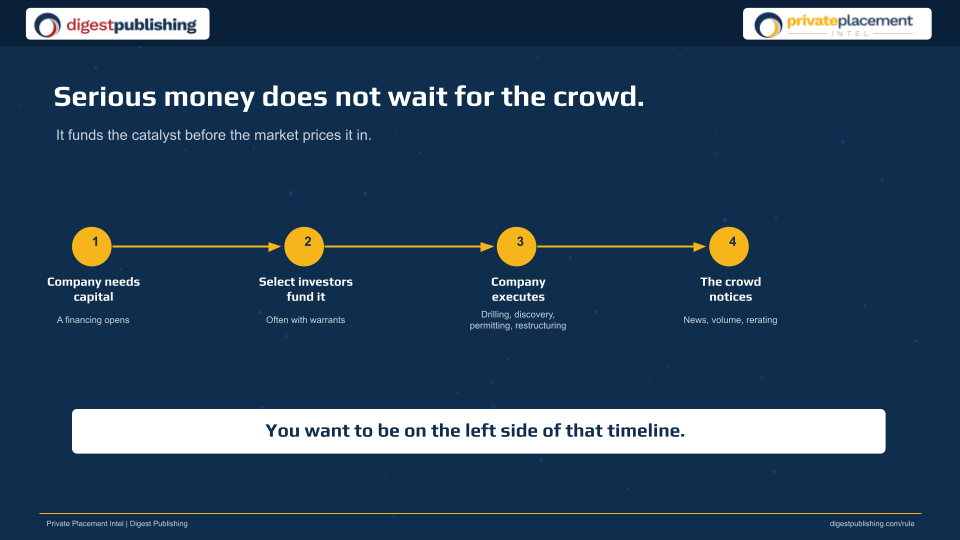
That is where private placements come in.
A lot of early-stage resource companies need capital to do what they are promising to do. They need money to drill, acquire a project, run geophysics, consolidate land, complete a transaction, or answer some unanswered question.
Because they are not generating revenue, that capital has to come from investors.
In many cases, it comes from a select group of investors.
That "select group” is important. And you can become a member of it.
That select group often funds the company before the broader public story begins. They put capital directly into the treasury. The company uses that money to execute. If the work goes well, the story starts to move from private conversations to public awareness.
The drill results come out. The company tells its story. Interviews appear. Marketing begins. Newsletter writers take notice. Retail investors start looking at the stock.
By that point, the early financing investors may already be positioned.
That is the private placement edge.
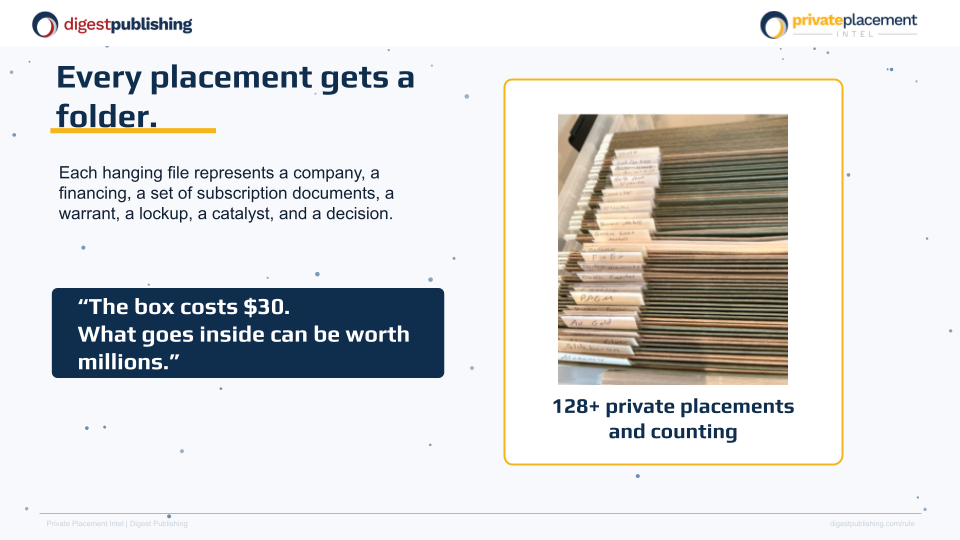
I’ve been doing private placements for more than a decade. I’ve written 128 checks into different companies, sometimes into the same company more than once as it continued to execute.
Every deal gets a hanging folder. I keep the subscription documents, correspondence, wire confirmations, emails, warrant information, and other records together so I have a complete history of the financing.
I’ve gone through a couple of those boxes at this point. Each box costs about $30.
The contents inside can be worth millions.
The best example I can give you is Patriot Battery Metals, now PMET Resources.
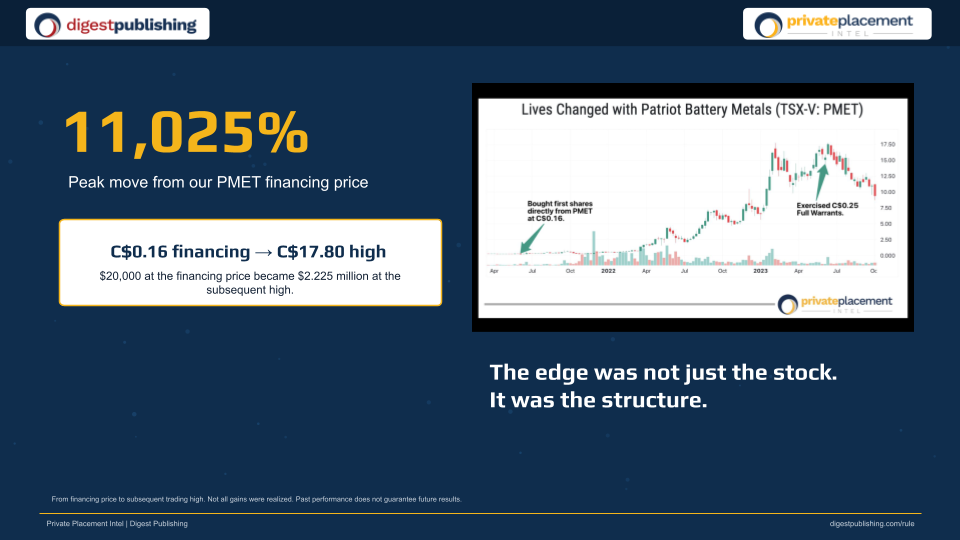
When we first financed it, the company was called Gaia Metals. We participated at C$0.16 per share. That financing helped the company go out and vet projects before it eventually settled on the Corvette property in James Bay, Quebec, where it made one of the largest and highest-grade lithium-cesium-tantalum discoveries in the world.
The stock later traded as high as C$17.80.
From a C$0.16 financing price, that was an 11,025% move. A $20,000 initial investment would have been worth more than $2.2 million at the peak.
But the entry price was only part of the opportunity.
That financing also came with full warrants at C$0.25. By exercising those warrants, the total outlay would have been just over $51,000, and the peak value would have been more than $4.4 million.
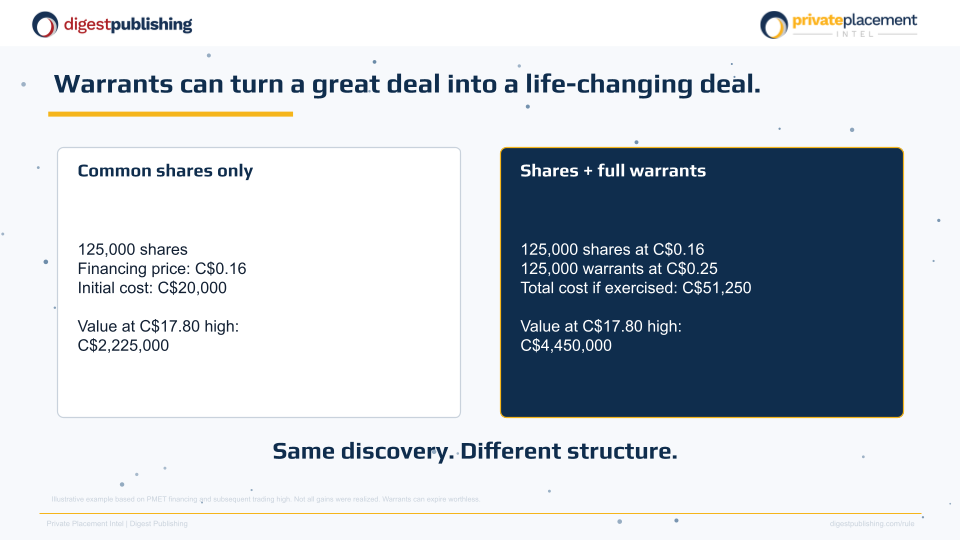
Nobody sells the absolute top. Anyone who says they do is lying. But whether a person sold PMET at $10, $12, $15, or somewhere else along the way, the structure created extraordinary upside.
That is why warrants matter.
A warrant gives you the right, but not the obligation, to buy more shares at a set price for a fixed period of time. It can expire worthless. Many do. But when a company executes, the warrant can turn a good deal into a great deal.
It is also important to be clear about what I do not mean by private placements.
I am not talking about crowdfunding, Reg A mass-market offerings, or private-forever deals where your capital disappears into a black hole. This is not about funding a restaurant, a video game, or some lifestyle business where the reward is a mug or a t-shirt.
I am talking about private placements in public equities, pre-IPO companies, IPO rounds, RTOs, CPC transactions, and companies with a clear path to liquidity.
That last part is essential.
You cannot profit if you cannot sell.
In these financings, you buy shares directly from the company. You are not buying from a shareholder who wants out. Your capital goes into the treasury and helps fund the next stage of the company’s plan.
That changes your place in the food chain.
Open-market buyers are usually reacting to news, recommendations, interviews, marketing, or a stock chart that has already moved. Private placement investors are trying to fund the catalyst before that public reaction happens.
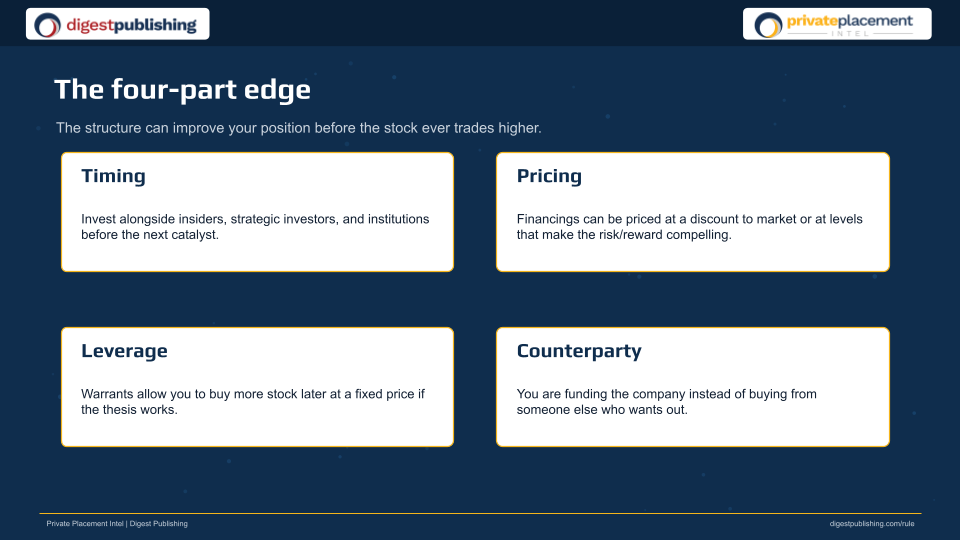
The edge has four parts: timing, pricing, leverage, and counterparty.
You come in early. You may receive a discount to the market. The financing often includes warrants. And instead of providing liquidity to someone else, you are helping finance the company’s next step.
Access, however, is only part of the equation.
You still have to know what to underwrite.
At Private Placement Intel, we focus on people, paper, project, price, and path.
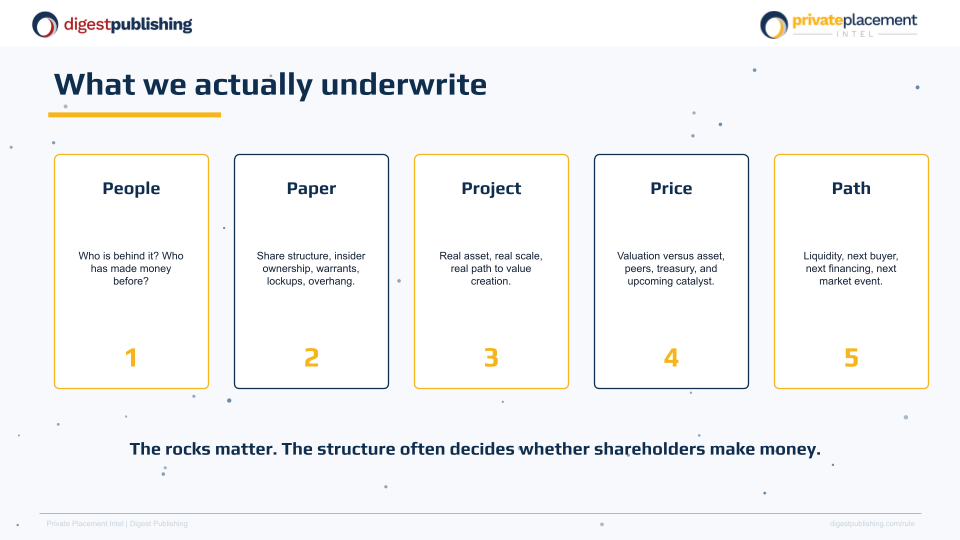
People means we want managers, geologists, financiers, and operators who have done something relevant before. Paper means we care deeply about the share structure, insider ownership, cheap stock, warrants, rollbacks, lockups, and who else is on the cap table.
The project has to be real. We are not geologists, but we talk to geologists. We do not want some moose pasture that gets recycled every cycle because nobody has ever been able to make it work.
Price matters because even a good asset can be a bad investment at the wrong valuation.
Path means there must be a visible route to liquidity or recognition. That could be a drill program, a resource, a partner deal, a strategic investment, a takeover, a public listing, or a larger financing that moves the company to the next stage.
A good example is Kincora Copper.
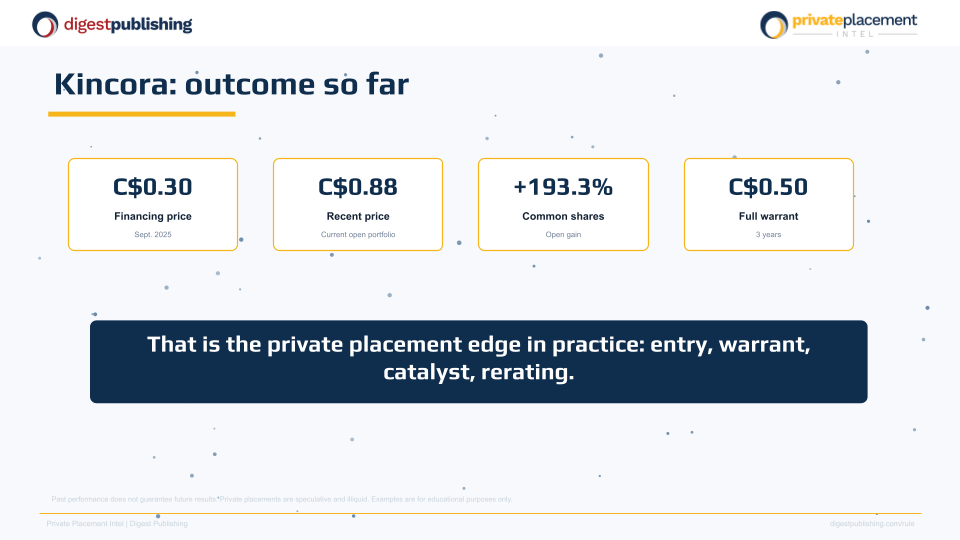
We financed Kincora at C$0.30 in a restructuring-stage placement alongside Rick Rule and Jeff Phillips. The financing included a full warrant at C$0.50 for three years.
What made it interesting was not just the copper story. It was the setup.
Kincora had serious technical credibility, a cleaned-up structure, strategic investors, exposure to the Macquarie Arc in Australia, and a partner-funded exploration model that could advance projects without forcing shareholders to carry every dollar of dilution.
Kincora now trades around C$0.88, nearly 200% above the financing price, with the warrant firmly in the money.
North Shore Uranium is another useful example.
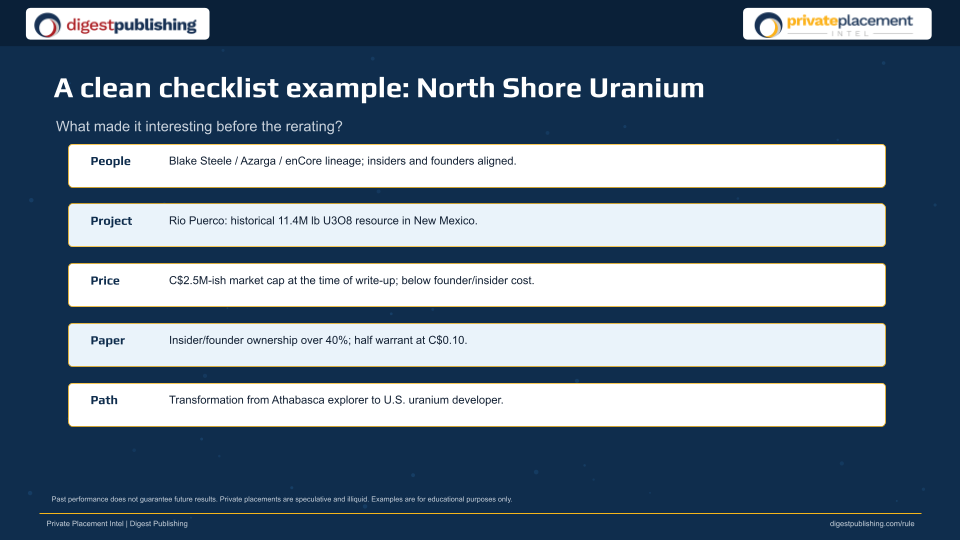
This was a company pivoting from an Athabasca Basin prospect generator into a focused U.S. uranium developer through the Rio Puerco project in New Mexico. The project had a historical 11.4 million pound uranium resource, a prior mine buildout that never reached production, and a new thesis around potential ISR development.
The people mattered. Blake Steele came in as an investor and director. We had invested with Blake before through Azarga Uranium, which was eventually acquired by enCore Energy.
When we first financed North Shore at C$0.05, the market cap was roughly C$2.5 million. There was meaningful insider ownership, and the financing came with C$0.10 warrants.
Shares have been up about 360%, and the warrants have been deep in the money.
The edge is not magic.
It is access, diligence, structure, valuation, and patience.
When those pieces line up, private placements can be one of the most powerful ways to invest in junior resource companies before the crowd gets there.
That is the world we built Private Placement Intel to cover.
Click here to see how we source, evaluate, and participate in these deals — and how you can become part of the select group that does them with us.
Call it like you see it,

Nick Hodge
Publisher, Bizarro World