Nick Hodge,
Publisher
Sept. 8, 2026
Three shuttered American reactors are being revived with billions in federal backing. Every one of them will need uranium.
COVID killed more than the elderly and overweight.
It killed businesses. It killed demand. It killed plans.
And in Iowa, the chaos of 2020 helped finish off a nuclear power plant that was already marked for closure.
The Duane Arnold Energy Center was Iowa’s only nuclear plant. It had operated for 45 years and was scheduled to be decommissioned in October 2020.
Then, on August 10, a derecho ripped across the Midwest.
Most people outside the region have forgotten about it, if they ever heard about it at all. But the storm sent hurricane-force winds through Iowa, with gusts topping 120 miles per hour around Cedar Rapids.
Duane Arnold’s cooling towers suffered extensive damage.
With fewer than three months remaining before the scheduled closure, owner NextEra Energy decided the repairs no longer made economic sense. The reactor shut down early and never restarted.
The employees scattered. Some retired. Some found other jobs. The plant began preparing for permanent decommissioning.
That was then.
Six years later, Duane Arnold is coming back from the dead.
NextEra plans to restore the 615-megawatt reactor and return it to service by the first quarter of 2029. New cooling towers, a generator, a transformer, and other major equipment have already been ordered.
Google has signed a 25-year agreement to buy most of the electricity, primarily to support its growing cloud and artificial-intelligence operations in Iowa.
And now the federal government is putting serious money behind the restart.
The Department of Energy has closed on a loan of up to $1.9 billion to help NextEra bring Duane Arnold back online.
That loan does not eliminate the need for approval from the Nuclear Regulatory Commission. NextEra must still demonstrate that the plant, its equipment, and its operating programs meet federal safety requirements.
But Washington has made its intentions obvious.
The federal government wants this reactor running again. Google wants the electricity. NextEra is ordering the equipment. Former plant employees are returning to Iowa to help rebuild what they once believed was gone forever.
And Duane Arnold is only one piece of a much larger story.
Billions for Nuclear Restarts
In Michigan, Holtec International is working to restart the Palisades nuclear plant, which closed in 2022.
The Biden administration backed that effort with a $1.52 billion federal loan. Despite delays related to its steam generators, Holtec has started the process of loading nuclear fuel into the reactor.
In Pennsylvania, Constellation Energy is reviving Unit 1 at Three Mile Island — the undamaged reactor at the infamous nuclear site.
Microsoft has signed a 20-year agreement to purchase the power for its data centers. The Trump administration has backed the restart with another $1 billion federal loan.
Palisades under Biden.
Three Mile Island and Duane Arnold under Trump.
The political rationale may change. Democrats emphasize carbon-free electricity. Republicans emphasize energy dominance, grid reliability, and national security.
But the loans keep coming from both parties that don’t agree on much else.
Just these three restarts could return more than 2.2 gigawatts of around-the-clock electricity to the American grid.
And we are still talking about previously closed reactors.
The Energy Department has also committed up to $17.5 billion to help utilities purchase long-lead components for as many as 10 new Westinghouse AP1000 reactors.
China has dozens of reactors under construction. Canada wants 10 new reactors by 2040 while doubling uranium exports. Japan is restarting reactors it idled after Fukushima. India, France, South Korea, and other nations are expanding their nuclear fleets.
Governments need more reliable electricity.
Big Tech needs enormous quantities of it.
Both have arrived at the same solution.
The Profitable Problem
Every one of these reactors requires uranium.
The existing fleet already consumes more uranium than the world’s mines produce. Utilities have made up the difference by drawing down inventories and buying material from secondary sources.
Now we are extending the lives of old reactors, restarting shuttered ones, and building new ones.
Meanwhile, new uranium mines remain difficult, expensive, and slow to permit.
The Financial Times recently published the following forecast from Stifel:
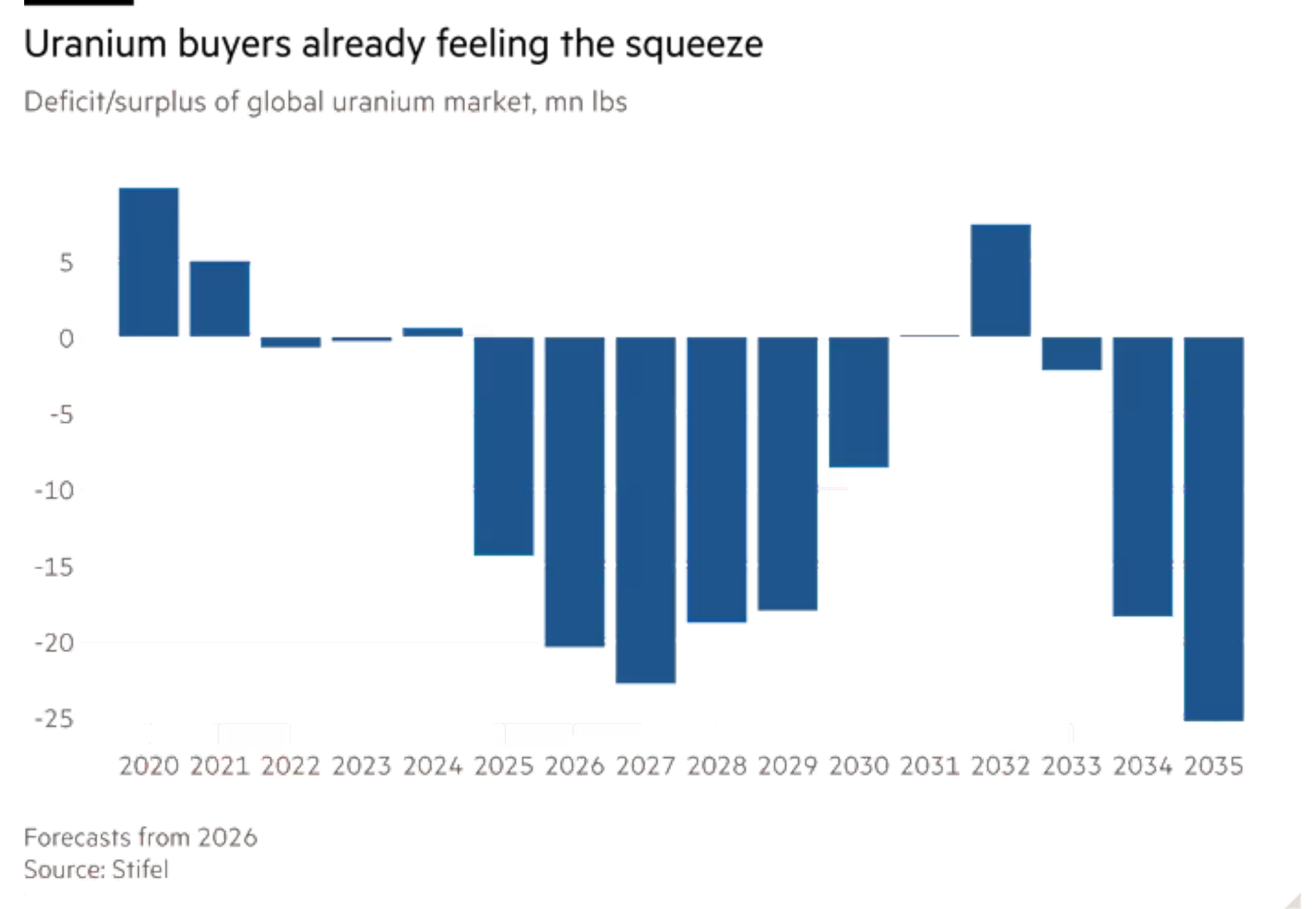
Stifel projects global uranium deficits in nearly every year through 2035, including shortfalls approaching 20 million to 25 million pounds in several years.
The geopolitical picture makes the problem even more serious.
Russia produced only about 5% of the world’s mined uranium in 2024. But once you include Russian-controlled mines in Kazakhstan and elsewhere, Moscow controlled nearly a quarter of global production capacity.
Researchers warn that figure could reach 36% by 2040.
The United States is trying to reduce its reliance on Russia just as new American reactors and restarts begin competing for fuel. Europe, China, India, Japan, and the rest of the nuclear world will be competing for many of the same pounds.
Utilities are already responding.
The long-term uranium price has climbed from approximately $80 per pound a year ago to $94 — its highest level in 18 years and within striking distance of $100.
Those prices are moving before the largest wave of replacement contracting has begun.
Herein lies the profitable problem:
Big Tech can sign a power agreement tomorrow.
Washington can approve another billion-dollar loan next month.
But it takes a uranium miner a decade or more of permitting, financing, and construction to ramp up a new mine.
Demand is accelerating much faster than supply can respond.
The Third Convergence Event
This is what my business partner Gerardo Del Real calls the “Third Convergence Event.”
A structural supply shortage is colliding with massive government intervention and a powerful new buyer that barely existed during the last uranium boom.
That buyer is Big Tech.
During the previous uranium cycle, the uranium price ran from roughly $10 per pound to $136.
Energy Fuels gained 13,275%.
Laramide Resources gained 30,800%.
Paladin Energy gained 130,400% — enough to turn a $1,000 investment into more than $1.3 million.
The biggest gains came from small uranium companies that controlled the pounds the market suddenly needed.
Gerardo has spent months studying the companies positioned to supply this next cycle. He has narrowed the field to three specific uranium investments he believes offer the best combination of leverage, assets, and upcoming catalysts.
He lays out the entire opportunity in his new video presentation, including the strange little “Energy Stone” at the center of it all.
Click here to watch Gerardo’s new presentation, The $10 Trillion Energy Stone, and see the three uranium investments he is recommending now.
The reactors are coming back.
The uranium supply is not.
Position accordingly.
Call it like you see it,

Nick Hodge
Publisher, Bizarro World