Gerardo Del Real,
Editor
Sept. 22, 2026
The nuclear renaissance just received a $50 billion price tag.
Bloomberg reports that Westinghouse Electric is targeting a valuation of more than $50 billion in a potential U.S. initial public offering.
That’s the same Westinghouse whose technology is used by 57% of the world’s nuclear reactors.
The company has identified as many as 91 opportunities for its latest-generation reactor.
And here’s the part that really caught my attention…
Cameco and Brookfield acquired Westinghouse in 2023 at a valuation of roughly $8 billion.
Three years later, it could return to the public market worth more than six times that amount.
Money is flooding back into nuclear.
But the reactors are only one part of this story.
Every existing reactor, every restart, every life extension, and every new nuclear facility will require fuel.
That’s where the real bottleneck is developing.
Uranium Is Already Responding
Spot uranium is approaching $90 per pound.
That’s about five times the price producers were receiving near the bottom of the post-Fukushima downturn.
More importantly, long-term uranium contract prices have reached their highest level in at least 18 years.
These are the contracts utilities use to secure the fuel their reactors will need years from now.
Utilities are conservative buyers. They don’t wait until the last minute and hope uranium shows up.
When they see a shortage coming, they lock up supply.
That contracting cycle is now underway.
Jefferies recently raised its long-term uranium forecast by 36% to $95 per pound.
Citi believes spot uranium could reach $140 per pound by late 2027.
The uranium enrichment market is even tighter.
Enrichment prices have climbed from roughly $65 per separative work unit in February 2022 to approximately $181 today.
Outside Russia and China, only two established providers — Urenco and France’s Orano — currently possess meaningful enrichment capacity.
The United States is attempting to build a domestic alternative through Centrus Energy. The Department of Energy awarded the company a $900 million task order earlier this year.
But commercial-scale capacity takes years to build.
Meanwhile, temporary waivers allowing certain Russian uranium imports are scheduled to expire on January 1, 2028.
The clock is ticking.
Big Tech Has Entered the Market
The uranium bull market used to depend almost entirely on electric utilities.
That has changed.
The largest technology companies on Earth are now hunting for enormous amounts of dependable, around-the-clock electricity.
Wind and solar can contribute power to the grid. Data centers, however, cannot shut down when the sun sets or the wind stops blowing.
Artificial intelligence requires reliable electricity every second of every day.
That makes nuclear power uniquely valuable.
Google recently signed an agreement with Nordic utility Fortum to support its Finnish data centers while extending the life of the Loviisa nuclear plant.
Microsoft has signed a 20-year power agreement tied to the restart of Three Mile Island.
Meta has secured 20 years of nuclear power in Illinois and says it wants gigawatts more.
Amazon paid $650 million for a data-center campus connected directly to Pennsylvania’s Susquehanna nuclear plant.
These companies can afford nearly any price required to secure power.
What they cannot do is manufacture uranium deposits, permitted mines, conversion facilities, or enrichment capacity overnight.
Somebody still has to find the uranium. Somebody has to permit it. Somebody has to mine it.
The Third Convergence Event
I call what’s happening now the Third Convergence Event.
Three powerful forces are colliding:
- A supply chain weakened by decades of underinvestment.
- A government scramble to rebuild domestic nuclear infrastructure and reduce dependence on Russia.
- And an entirely new class of buyer arriving with practically unlimited capital and an urgent need for electricity.
We saw similar conditions during previous uranium cycles.
Uranium climbed more than sevenfold following the 1973 energy crisis.
During the last major cycle, spot uranium rose from approximately $10 per pound in 2003 to $136 in 2007.
The best-positioned junior uranium companies produced gains of 10,000%, 30,000%, and — in a few extraordinary cases — more than 100,000%.
Past performance never guarantees future results.
But resource markets continue to follow the same basic law:
When demand rises faster than supply can respond, prices must increase until new production becomes economically attractive.
Building a mine can take seven to 10 years.
Big Tech doesn’t have that long to wait.
The Stocks Have Pulled Back
Here’s what makes the current setup so attractive…
Nuclear and uranium equities have corrected even as the underlying fundamentals have strengthened.
The Global X Uranium ETF, better known by its ticker URA, recently traded around $43.
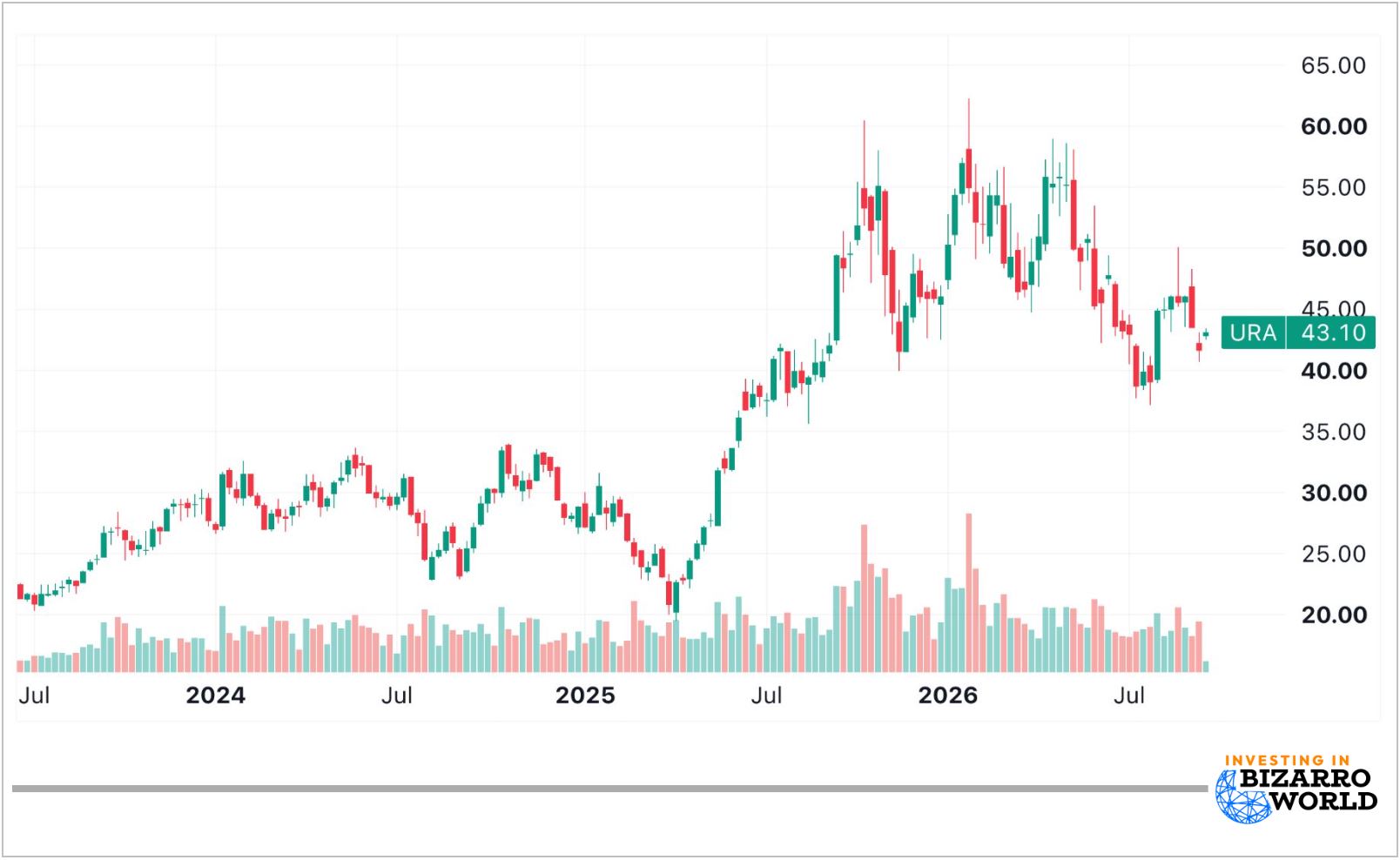
That puts it roughly 30% below the highs it reached in late 2025 and early 2026.
The uranium price is rising.
Long-term contract prices are at an 18-year high.
Enrichment prices have nearly tripled since early 2022.
Data-center demand is accelerating.
Governments are supporting nuclear development.
Yet the uranium equities are cheaper than they were months ago.
This is the kind of disconnect I look for.
The correction has also exposed the speculative end of the nuclear market. Standard Nuclear and X-Energy both trade below their IPO prices, while Holtec postponed its planned offering.
That is healthy.
A powerful investment theme will still contain weak companies, overvalued stories, excessive dilution, and management teams that cannot execute.
The opportunity comes from identifying the small group of companies positioned at the most valuable points in the supply chain.
Three Ways to Position Yourself
I’ve spent the past several months reviewing the North American uranium companies that could benefit most from this Third Convergence Event.
I narrowed the field to three primary investments.
The first is an American uranium producer already pulling material from the ground, with licensed processing infrastructure and substantial in-ground resources.
The second is a higher-leverage North American explorer controlling a major land position across two prolific uranium regions.
The third provides direct exposure to physical uranium without the operational risks of running a mine.
I’ve also identified a more speculative Athabasca Basin wildcard with exposure to one of the richest uranium districts on Earth.
The names, ticker symbols, recommended buy ranges, and complete investment cases are contained in my new report, "The Third Convergence Event: Three Uranium Stocks That Could Turn a Small Stake Into a Fortune."
I explain the full opportunity in my new video presentation, The $10 Trillion Energy Stone.
You’ll see why Big Tech’s electricity crisis is changing the uranium market, why the Western fuel supply chain is dangerously vulnerable, and how you can access my complete research on the companies I believe are best positioned.
The nuclear renaissance is no longer a prediction.
Westinghouse is preparing for a potential $50 billion IPO.
Uranium is approaching $90 per pound.
Utilities are locking in long-term supply.
And the largest technology companies in history are committing billions of dollars to nuclear power.
The uranium stocks have given us a pullback while all of this is happening.
I suggest you use it.
Watch The $10 Trillion Energy Stone presentation now and discover the three uranium investments I’m putting my own money behind.
Let's get it,

Gerardo Del Real
Editor, Bizarro World