Chris Curl,
Editor
Aug. 27, 2026
While American investors remain obsessed with the next AI model, China is staging the opening ceremony for physical AI.
The recent Unitree IPO was not subtle. One of the world’s leading humanoid-robot makers raised about $905 million in Shanghai, then saw its shares surge more than 500% in its market debut after retail demand oversubscribed the offering by more than 8,000 times.
That is not just a hot IPO. It is a sign that China has decided humanoid robotics is a national industrial priority and that its domestic capital markets are ready to fund it accordingly.
Then came the World Humanoid Robot Games in Beijing.
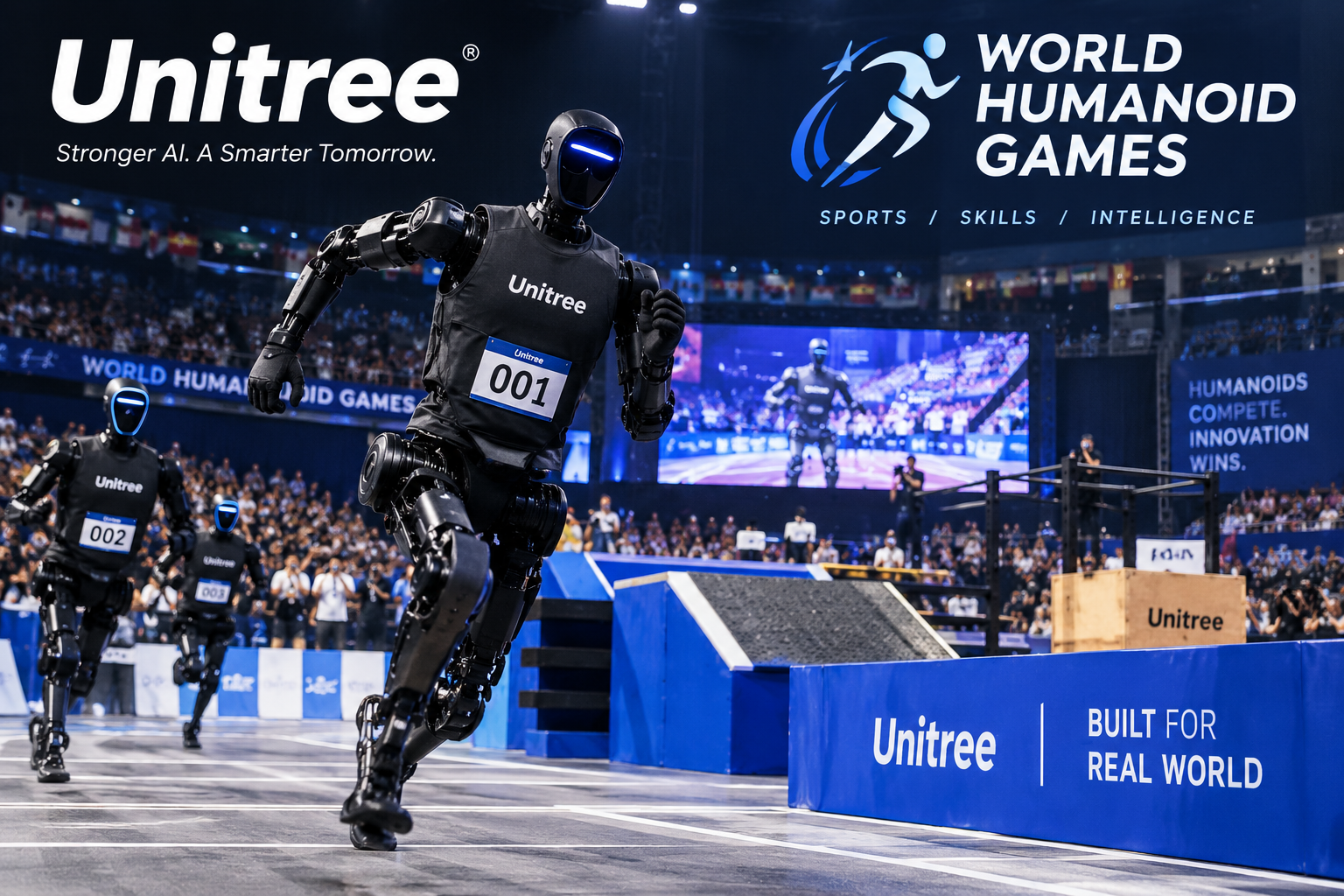
More than 2,000 robots from 16 countries descended on the city’s National Speed Skating Oval to run, play football, demonstrate martial arts, lift weights, and compete in a growing number of task-based events. The headline clips are easy to dismiss. Robots falling over, robots sparring, robot soccer—it can all look like a strange mixture of Olympics, trade show, and science-fiction convention.
That would be a mistake.
The important part is not the backflip or the sprint time.
The important part is the factory-floor test.
This year’s Games include scenarios built around packing and warehousing, industrial assembly, material feeding, retail service, office work, EV charging, cable connection, and tool use. Organizers are pushing teams toward longer, more continuous tasks in messy environments rather than just staging a ten-second demo for the cameras. That is the transition that matters. The moment robots can consistently perform useful work, the conversation moves from “Can it dance?” to “How many can we deploy?”
And China is clearly preparing for the second question.
Unitree shipped more than 5,500 humanoid units in 2025, making it the global leader by volume, while Beijing’s World Robot Conference drew more than 300 exhibitors and over 3,000 products this year. The country is not waiting for perfect robots before building the supply chain, training the workforce, opening the capital markets, and normalizing the idea that embodied AI belongs in factories, stores, warehouses, and homes.
That is the real story American investors are missing.
The United States has extraordinary robotics companies. Tesla has Optimus. Figure has become one of the most closely watched private companies in the space. Boston Dynamics, Agility, 1X, Apptronik, and a growing list of startups are pushing hard on hardware, dexterity, and deployment. Nvidia has built the simulation and compute stack that may become the operating system for physical AI.
But China is doing something different. It is turning robotics into an ecosystem.
It is putting robots on television. It is putting them in competitions. It is funding the manufacturers. It is pushing the component supply chain. It is creating domestic demand. And it is letting a company like Unitree become a public-market symbol of the entire national push.
That kind of infrastructure compounds.
The same thing happened in electric vehicles. China did not need to invent every battery chemistry or every automotive software layer to build a dominant position. It needed to commit to scale, build supply chains, push costs down, and make the product normal. Robotics is following the same script. The unit economics will improve as production expands. Components will standardize. The data generated by deployments will improve the models. More capable robots will unlock more demand. Then the cycle accelerates.
This is why the robotics thesis is bigger than any one robot, any one IPO, or any one viral video.
We are watching the birth of a new industrial layer: machines that can see, reason, move, manipulate objects, and eventually work alongside (or in place of) human labor. The first version will be imperfect. It will be clumsy, expensive, and unevenly deployed. But so were the first personal computers, smartphones, and electric cars. The long-term opportunity does not depend on a robot being perfect in 2026. It depends on the curve continuing to improve while the cost curve continues to fall.
China is betting that it will.
American investors should be paying closer attention.
Because the public-market opportunity is still remarkably underdeveloped in the United States. Much of the best exposure remains private, fragmented, or buried inside diversified industrial companies. Meanwhile, China is already giving its investors a direct, high-profile way to participate in the humanoid race. Unitree’s IPO is a reminder that capital markets eventually catch up to technological reality—but by then, the earliest gains are often gone.
That is why Digital Dispatch exists.
It tracks the full physical-AI map: humanoid platforms, robotic hands, actuators, sensors, simulation software, autonomy stacks, component suppliers, manufacturing bottlenecks, and the companies building the rails beneath the robot boom. It follows China’s scale push without losing sight of the American innovators working to build the underlying intelligence. It separates the viral demo from the real deployment signal.
The Unitree IPO and the Humanoid Robot Games are not proof that the robotics revolution has already arrived.
They are proof that it is no longer waiting quietly in the lab.
China is all in.
The rest of the market is still watching the highlights.
Digital Dispatch is built for investors who want to understand what comes next.
Click here to get started.
Keep coming back,

Chris Curl
Editor, Bizarro World