Chris Curl,
Editor
Sept. 3, 2026
The AI boom is no longer constrained by models, chips, or even data-center real estate.
It is constrained by electricity.
Every new hyperscale campus, GPU cluster, and AI inference network needs power that is not merely abundant, but available every hour of every day. This is the physical reality hiding underneath the software story. Artificial intelligence may feel abstract when it lives inside a chat window, but the infrastructure behind it is brutally tangible: acres of servers, mountains of copper, substations, transformers, cooling systems, transmission lines—and a constant, industrial-scale demand for electricity.
That demand is becoming impossible to ignore.
Data centers are projected to account for roughly half of U.S. electricity-demand growth through the rest of the decade, while their share of total domestic power use could rise from about 4% today to roughly 9% by 2030. The IEA expects global data-center electricity demand to rise sharply through 2030, with AI-focused facilities growing even faster than traditional cloud capacity.
The market keeps talking about “AI demand.” What it really means is power demand.
And not just any power.
A data center cannot run a trillion-dollar AI model on the hope that the wind blows at the right moment or that enough batteries are charged after sunset. These facilities need high-capacity, always-on electricity. They need baseload power—power that runs through the night, through storms, through heat waves, and through the periods when intermittent generation is producing little or nothing.
That is why nuclear is moving back to the center of the conversation.
Wind and solar will remain important pieces of the grid. They are increasingly cheap, fast to deploy, and useful in a diversified power system. But they are not, on their own, a realistic answer to a 24/7 industrial load that can measure demand in hundreds of megawatts or even gigawatts. Battery storage helps smooth volatility, but the scale required to provide firm, multi-day energy to a massive data campus remains enormous.
Natural gas can fill part of the gap, and it will. But gas faces its own problems: pipeline constraints, fuel-price volatility, emissions pressure, and the growing political risk of building decades of new fossil infrastructure just as the world demands lower-carbon power.
Nuclear is different.
It produces firm, high-density electricity around the clock. It takes up a fraction of the land required for comparable renewable output. It does not depend on weather. And it gives a company building a data center something no spreadsheet can ignore: certainty.
That is why the hyperscalers are no longer treating nuclear as a distant policy conversation. They are treating it as a strategic resource.
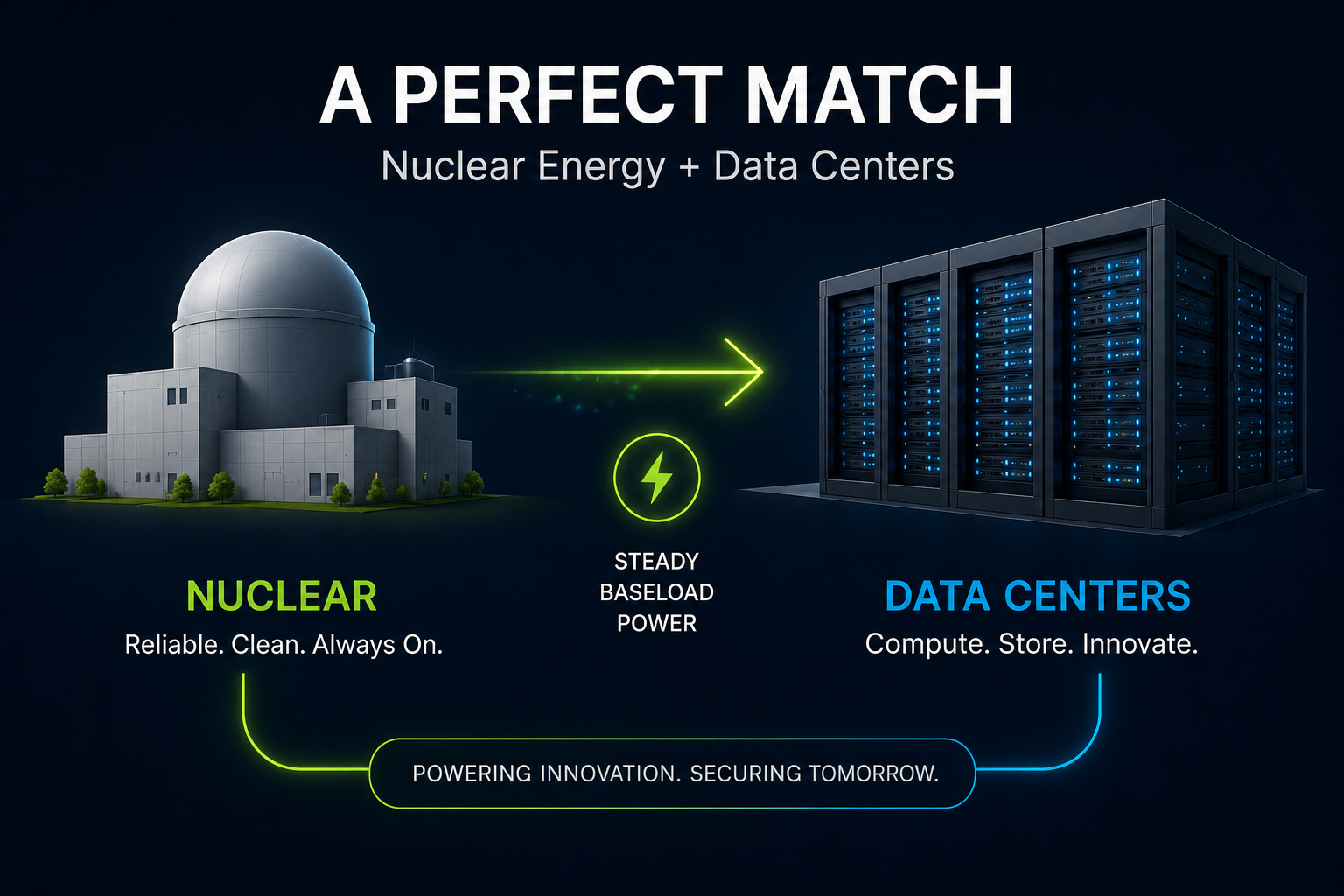
Announced nuclear agreements involving major technology companies now total roughly 13 gigawatts across power-purchase agreements and direct partnerships. Yet even if every one of those projects reaches completion, the output would cover less than 20% of estimated hyperscaler electricity demand through 2035. That is not a reason to dismiss nuclear. It is the reason the uranium thesis is becoming more urgent.
The demand arriving from AI is larger than the first round of supply commitments.
And every new reactor, life extension, restarts of idled facilities, and small modular reactor plan eventually leads back to the same input: uranium.
For too long, uranium was treated as a niche commodity with a complicated history and an uncertain future. The market assumed that nuclear power belonged to the past, that renewables would replace everything, and that new supply would appear whenever prices rose. That complacency is breaking down.
The world wants more reliable power. Governments want domestic energy security. Utilities want firm generation. Data-center operators want dependable electricity. And the uranium market is still far too small, too concentrated, and too slow-moving to absorb a sustained supply shock without consequences.
This is what makes uranium a must-have asset in the AI buildout.
Not because every reactor proposal gets built. Not because every junior explorer becomes a winner. And not because uranium is immune to volatility. It is because the underlying demand is being driven by forces far larger than a commodity cycle: national security, grid stability, industrial policy, and now the capital spending race around artificial intelligence.
The AI trade has already rewarded the obvious names—chips, cloud providers, data-center operators, and power equipment makers. Uranium sits one layer beneath them, where the market is only beginning to appreciate the scale of the constraint.
That is where the best resource opportunities often begin.
The next phase of the AI buildout will not be decided only by who has the fastest model. It will be decided by who can secure the power to run it.
And if nuclear is becoming the indispensable baseload solution, uranium is no longer optional.
It is strategic.
The nuclear renaissance is now a Wall Street reality. The uranium cycle is accelerating and a major convergence event is already in motion.
Click here to uncover The $10 Trillion Energy Stone
…the essential resource at the heart of this collision, and the three specific uranium plays positioned to lead as this new chapter begins.
Keep coming back,

Chris Curl
Editor, Bizarro World