Chris Curl,
Editor
Oct. 22, 2026
Elon Musk found a way to make a long-delayed sports car the center of attention again.
Drive it up a ridiculous ramp. Turn it upside down. Launch it into the air. Use thrusters to bring it back to Earth.
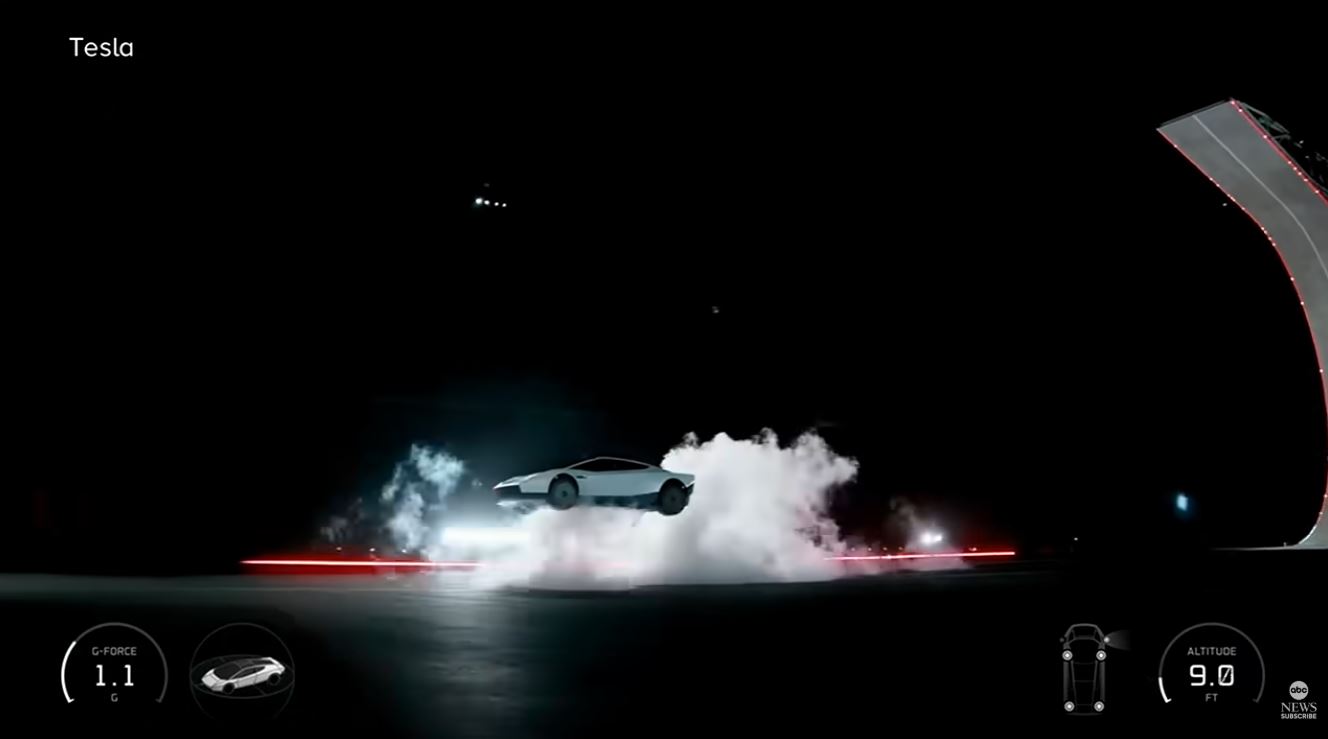
At the Roadster unveiling at SpaceX’s Texas testing facility, Tesla demonstrated a vehicle that could cling to a curved ramp, launch off it, and land with help from compressed-gas thrusters developed through collaboration with SpaceX.
Was it impressive? Absolutely.
Was it necessary? Unless your commute involves jumping over a row of parked cars, probably not.
As a practical transportation demonstration, the whole thing was absurd. As a publicity stunt, it did its job. The Roadster was back in the headlines, complete with footage far more likely to circulate than another presentation about range, charging, or manufacturing costs.
Musk understands something many executives never learn: people will scroll past a product specification. They will stop for a flying car.
But I think the more important message was sitting underneath the spectacle.
He was showing investors what Tesla and SpaceX look like when the distinction between them starts to blur.
The Car Was the Advertisement
The Roadster is not proof that a merger is happening. No transaction was announced at the unveiling. But the collaboration has intensified speculation about a combination, and Musk himself described the SpaceX-developed hardware as a small example of the synergies between the companies.
That is the part worth watching.
Here was a Tesla product, demonstrated at a SpaceX facility, using technology developed with SpaceX engineers. You did not need a corporate-structure chart to understand the pitch.
The car was effectively an advertisement for putting the two businesses closer together.
Not the first hint of that ambition, but perhaps the clearest visual sales pitch yet: stop looking at these as separate companies that occasionally share a CEO. Start imagining what they could build as one.
My reading is that Musk wants investors comfortable with the idea of a supercompany before anyone has to evaluate the terms of an actual deal.
The stunt gets your attention. The collaboration gives the speculation something tangible to attach to.
Much Bigger Than Cars and Rockets
Imagine the investment story such a combination would offer.
Cars and autonomous driving. Humanoid robots. AI. Rockets and launch infrastructure. Satellites and global communications. Energy storage and the manufacturing systems needed to build all of it.
That is not just a larger automaker or a better-funded aerospace company. It is an attempt to bring a substantial part of the physical-AI economy under one roof.
The potential connections are easy to see. Robotics and vehicles share challenges in perception, control, batteries, and manufacturing. Space systems demand expertise in materials, communications, propulsion, and operating hardware under difficult conditions. AI could become a common tool across engineering, autonomy, and operations.
None of that means the technologies transfer effortlessly. A robot is not a car, and a satellite network is not an autonomous-driving system. Shared ownership does not magically solve engineering problems.
But the broader ambition is coherent: develop intelligence, give it machines to operate, manufacture those machines at scale, and build the communications and energy infrastructure around them.
Seen that way, the flying Roadster is less interesting as a product than as a demonstration of how Musk wants people to think about his businesses.
A Great Story Still Needs Good Terms
This is where investors need to keep their feet on the ground, even if the car does not.
A dramatic collaboration is not evidence that a merger would create value for both sets of shareholders. The price matters. The ownership split matters. Governance matters. So does the possibility that a profitable division ends up financing another division’s enormous ambitions.
“Synergies” is one of the most expensive words in finance when nobody insists on measuring them.
And the Roadster itself remains a reminder of the distance between spectacle and execution. Despite the demonstration, production is targeted for 2028, and questions remain about whether its more extreme features would be permitted on public roads.
A vehicle can clear a ramp long before a business clears its commercial hurdles.
The same caution applies to a potential Tesla–SpaceX combination. Putting the pieces together could create extraordinary capabilities. It could also create an extraordinarily complicated company with enormous capital requirements.
Both deserve attention.
Watch What the Spectacle Is Selling
I would not dismiss the Roadster launch just because it was ridiculous. Ridiculousness was part of the point.
Musk got people watching. Then he put Tesla and SpaceX in the same frame and showed them building something neither would ordinarily build alone.
Whether a formal merger follows remains an open question. But the investment narrative is taking shape: not cars versus rockets, not AI versus robotics, but an integrated platform spanning all of them.
That is exactly the kind of development I follow in Digital Dispatch.
The job is not to cheer every Musk demonstration or dismiss every ambitious idea as hype. It is to work out what is changing, where the economics make sense, and whether the stock price leaves anything for the investor.
The Roadster got the headlines.
The possible combination behind it deserves scrutiny.
Subscribe to Digital Dispatch to follow that bigger story as well as the opportunities and risks emerging as AI, robotics, transportation, and space move closer together.
Click here to get started.
Keep coming back,

Chris Curl
Editor, Bizarro World