Nick Hodge,
Publisher
Sept. 28, 2026
America’s K-shaped economy is pulling people in two opposite directions. Private placements have put us on the rising arm — and a new Prime Window is about to carry us higher.
Take a pen and write a capital K.
A vertical stem holds the letter together while two diagonal arms split from the same middle point. In handwriting terminology, the line reaching upward is the ascendent line. Its highest point is the apex; the other arm angles down and away.
That shape has become a map of the American economy.
A small but powerful group continues accumulating assets, capital and opportunity while millions of others lose ground to inflation, debt and rising living costs.
U.S. Bank describes the upper arm of this K-shaped economy as households and businesses with strong financial buffers, flexible income, appreciating assets and greater access to capital.
By contrast, those descending along the lower arm tend to have less savings, greater sensitivity to inflation and borrowing costs, and a heavier dependence on wages and credit.
More than 29% of America’s wealth now belongs to the top 1%, while the top 10% accounts for nearly half of all consumer spending.
Most commentators present those numbers as evidence of a problem.
I see them as an instruction.
Choose your line.
Your Position on the K Is Not Predetermined
Income matters, but ownership matters more.
Personal responsibility, ambition, independence and access to appreciating assets determine whether someone climbs or slides. People who rely entirely on wages must constantly outrun inflation, whereas owners benefit when businesses, real estate, commodities and financial assets increase in value.
That divide becomes even wider when you look at how capital is deployed.
Ordinary investors encounter companies after they are publicly traded, professionally promoted and widely known. They buy shares through a brokerage account at whatever price the market offers.
Serious private investors move upstream into capital formation.
Instead of purchasing shares from another investor on an exchange, they provide money directly to a company before an important drilling program, acquisition, discovery or corporate milestone. In return, they can receive private financing prices and warrants that preserve the right to buy additional shares later at a predetermined price.
That is the market where I built my wealth.
Private placements helped me leave my job, move my family across the country, establish a family office and create my own financial research company. They also gave me something conventional investors rarely possess: access to opportunities before the broader market understands that they exist.
I call that period the Prime Window.
It opens after we identify the opportunity but before the public assigns it full value. Entry prices are still low, catalysts remain ahead and warrants can provide another layer of leverage if the company succeeds.
Once the discovery arrives and the crowd comes rushing in, that window closes.
The Portfolio Proves the Point
Our current Private Placement Intel portfolio carries an average open gain of 234%.
PMET Resources entered the portfolio through a C$0.16 private placement. At its current C$4.33 price, that position is up 2,606%.
Exercised PMET warrants created another position at C$0.25, producing an additional 1,632% gain.
Q2 Metals began with a C$0.125 financing and has climbed to C$2.29, putting us ahead 1,732%. A later C$0.25 placement is up 816%, while shares acquired by exercising C$0.50 warrants have gained 358%.
Hannan Metals has advanced from our initial C$0.10 placement price to C$0.72 for a 620% return.
Several newer investments are moving up the ascendent line as well.
A gold-and-silver explorer financed at C$0.06 is now up 350%. Kingsmen Resources has gained 340%, Kincora Copper is ahead 240%, V Ten Metals has returned 196%, MineHub is up as much as 186%, and CoTec has delivered 142%.
Closed positions add even more proof.
Azarga Uranium returned 766%. Bravo Mining produced 681%. Critical Elements Lithium gave us 616%, followed by Rupert Resources at 553%, RESAAS Services at 550% and Aldebaran Resources at 495%.
Since 2021, the average result of the positions we closed each calendar year has remained positive. That record includes the brutal 2022 bear market, the dead junior-resource markets of 2023 and 2024, and the volatility that followed.
Every deal did not need to work.
A handful of carefully selected Prime Windows created enough wealth to overwhelm the misses and pull the entire portfolio upward.
That is the geometry of ascent.
Another Prime Window Is Opening
In March 2026, Private Placement Intel members financed a tiny Australian gold explorer at C$0.15 per share.
Members also received half-warrants exercisable at C$0.30 for three years.
At today’s price of approximately C$0.24, the shares have already gained 60%.
Now the same company is preparing to raise additional capital ahead of its first modern drill program, creating a second Prime Window for us to participate.
I met with the CEO last week at the Beaver Creek Precious Metals Summit. Sitting across from him, I could immediately tell how excited he was about the targets now being prepared for drilling.
He looked like the cat that ate the canary.
Months of historical research, fieldwork and geological interpretation have brought the company to this point. Old mine records have been digitized. Historic workings have been mapped. Surface exploration has confirmed what the old-timers documented more than a century ago.
The remaining step is to put drill holes beneath the gold.
Bonanza-Grade Gold at Surface
The project sits inside Australia’s Victorian Goldfields, a region responsible for approximately 80 million ounces of historical gold production.
Within this famous district, the company controls a nine-kilometer trend containing shallow historic mines, high-grade gold reefs and multiple parallel structures that have never been tested with modern drilling.
At the primary target, miners extracted ore averaging close to 23 grams of gold per tonne during the 1880s. Records describe some parcels running between one and ten ounces of gold per ton.
Visible gold occurred in quartz at or near surface.
Mining followed that mineralization underground through extremely narrow tunnels, often less than a meter wide. Work continued to a depth of roughly 350 to 400 feet before two problems overwhelmed the technology available at the time.
Heavy water flows became impossible to pump.
Then the miners encountered substantial antimony mixed with the gold.
Neither obstacle meant the structure had ended. They simply marked the limit of 19th-century mining.
Modern equipment can drill beneath those workings without entering the flooded tunnels. Today’s metallurgical technology can also process minerals that the old miners regarded as worthless or troublesome.
Antimony matters for another reason.
Once dismissed as a nuisance, it is now a valuable critical mineral required for defense systems, technology and energy storage. Its association with high-grade gold can also indicate the upper portion of an epizonal gold system.
That geological signature puts this project in the same broad family as Fosterville, Costerfield and Sunday Creek.
Deep drilling and mining have traced each of those Victorian systems to more than a kilometer below surface. At Fosterville, antimony appeared near the top before diminishing at depth as the gold grades increased.
Our company is preparing to drill beneath workings that stopped only about 107 meters down.
The deeper system remains untouched.
Multiple Reefs, Multiple Chances
Historical mining represents only the most obvious target.
Roughly 24 meters west of the main structure, an old exploration tunnel encountered a separate mineralized reef that was never properly followed up.
Another area just 150 meters away yielded over 500 ounces of coarse gold near surface.
Farther along the trend, a second historic mine followed gold-bearing reef mineralization for approximately 140 meters. Those workings reached a depth of only 180 feet before stopping, leaving the downward extension wide open.
A parallel reef lies roughly 10 meters east of the main structure.
Angled drill holes can test beneath the old workings while cutting across those adjacent reefs, giving the company several chances to intersect mineralization with each setup.
Management originally contemplated a 2,000-meter program. After assembling the historical records and refining the targets, the company began considering an initial campaign of between 3,000 and 5,000 meters.
More targets require more drilling.
More drilling requires more capital.
That requirement has created our next Prime Window.
A 225-to-1 Valuation Gap
Southern Cross Gold provides the most powerful comparison.
Its Sunday Creek project is another Victorian epizonal system containing high-grade gold associated with antimony. Success with the drill bit has carried Southern Cross to a market capitalization of approximately C$3.2 billion.
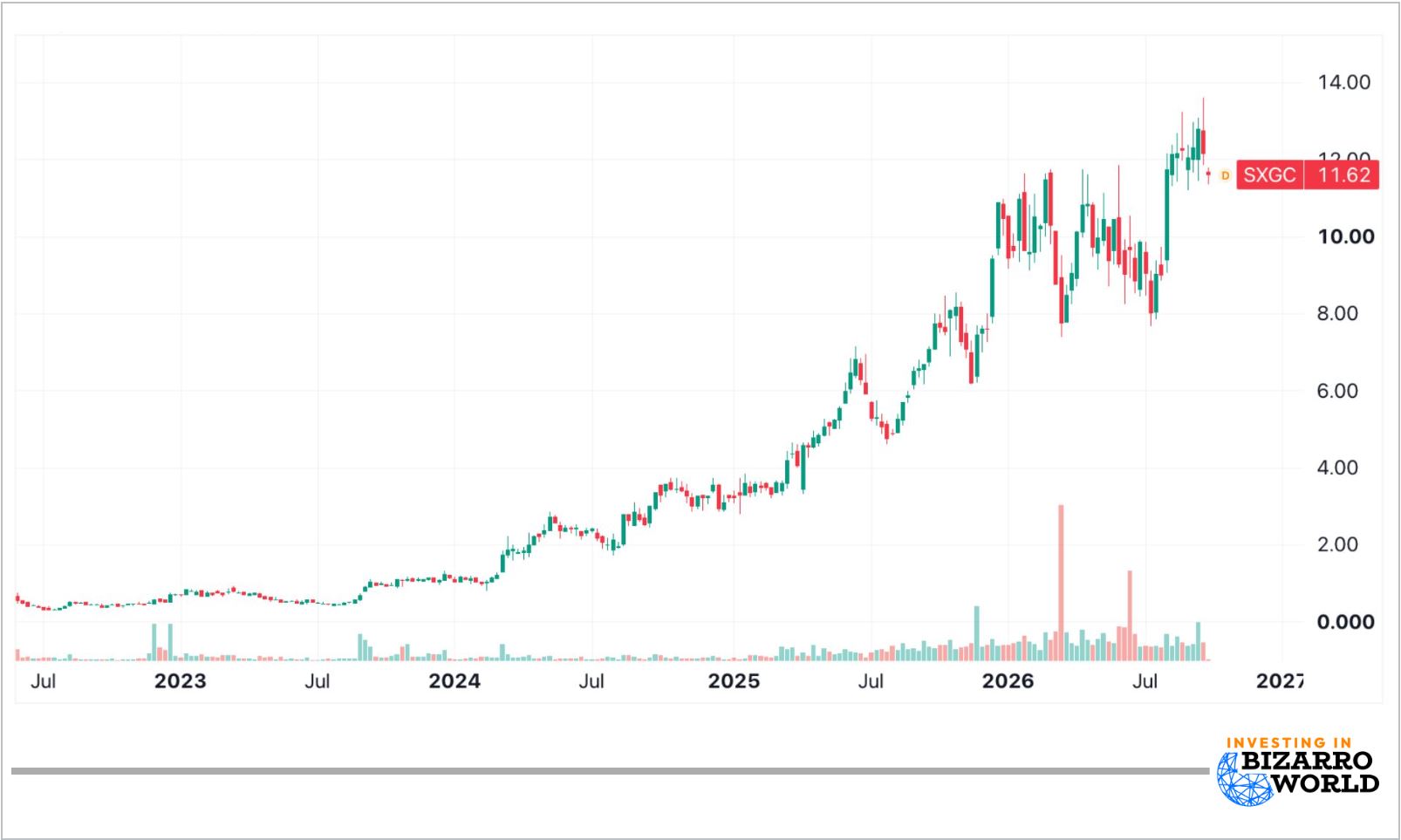
The tiny explorer we are preparing to finance is currently worth about C$14 million.
Southern Cross is therefore valued approximately 225 times higher.
Consider what even a partial closing of that gap could mean.
At one-twentieth of Southern Cross Gold’s valuation, our company would be worth C$160 million — more than 11 times its present market capitalization.
Reaching one-tenth would imply a value of C$320 million, almost 23 times where it trades today.
The full C$3.2 billion comparison is not required to produce an extraordinary result. A modest fraction would be enough to transform this C$14 million explorer into a major winner.
That is precisely why the financing is attracting attention.
Jeff Phillips, my longtime mentor and one of the most experienced junior-resource financiers I know, is involved and will participate alongside us.
Other sophisticated investors are preparing to join the placement, including people who recognized the potential of earlier high-quality gold-antimony stories before the market caught on.
They understand what could happen when modern drilling finally tests bonanza-grade historic gold beneath shallow Victorian mine workings.
So do I.
Capital Flows Upstream
Public investors usually arrive after a discovery has been announced.
They read the headline, pull up the chart and start buying into a stock that may already have doubled or tripled.
Private placement investors occupy the other side of that transaction.
Our capital pays for the drilling that creates the discovery. The financing price establishes our early position, while the warrants can preserve additional upside as the market begins recognizing what we financed.
By the time analysts initiate coverage, institutions build positions and financial media discover the story, the most lucrative entry may be long gone.
That is how capital flows in a K-shaped economy.
Those on the descending arm remain consumers of opportunities created and priced by somebody else. Ascendent investors become owners at the point where value is being created.
Private Placement Intel provides qualified investors with access to that point.
Members receive the same deals Gerardo and I enter with our own money, including the same financing prices and warrant terms. They also get the research, management access, portfolio updates and direct guidance required to participate intelligently.
Our next alert will cover this Australian gold-antimony financing.
Subscribers will learn the company’s identity, the complete financing terms and exactly how to express interest in participating alongside us, Jeff Phillips and the other capital now gathering around the deal.
Reach for the Apex
America’s economic divide will keep widening.
Asset appreciation, technological change and privileged access to capital will continue rewarding owners. Inflation and debt will keep eroding the purchasing power of people who depend exclusively on income.
No politician is coming to place you on the upper arm of the K.
That move requires deliberate action.
Private placements have been one of the most powerful tools I have found for making it. They provide an opportunity to invest before the crowd, receive terms unavailable through ordinary market purchases and build positions capable of producing genuinely life-changing gains.
A new Prime Window is opening now.
Behind it sits a C$14 million company with bonanza-grade historic gold, visible mineralization at surface, valuable antimony, multiple untested reefs and geological similarities to a company worth C$3.2 billion.
The CEO is ready.
Drill targets are prepared.
Experienced resource investors are moving into position.
Click here to see how these opportunities work and how you can participate in the next one.
The K gives you two directions.
Choose the ascendent line — and keep climbing toward the apex.
Call it like you see it,

Nick Hodge
Publisher, Bizarro World