Gerardo Del Real,
Editor
Sept. 1, 2026
For years, investors heard that nuclear energy was making a comeback.
Now the comeback has IPO filings, billions of dollars in federal backing, and some of the richest companies on Earth scrambling to secure nuclear power.
Westinghouse Electric, jointly owned by Cameco (NYSE: CCJ)(TSX: CCO) and Brookfield Renewable Partners (NYSE: BEP), recently submitted a confidential registration statement for a proposed initial public offering.
Holtec International, one of America’s largest nuclear suppliers, is also preparing to go public under the ticker HNUC. The company hopes to use the listing to help finance a $10 billion plan to expand from components and services into reactor design and nuclear plant operations.
General Fusion (NASDAQ: GFUZ), backed by Amazon founder Jeff Bezos, recently came public through a SPAC transaction valuing the company at an enterprise value of $724 million. It is the first publicly listed fusion company.
X-energy (NASDAQ: XE) had a billion-dollar IPO earlier this year. It’s building next-generation small nuclear power plants with Dow Inc., and has $2.15 billion in funding from the Department of Energy to get a plant up and running in Texas.
And Deep Fission (NASDAQ: FISN) fetched a $1 billion valuation when it listed in May.
All these listings send the same message: Capital is pouring back into nuclear energy.
Washington Is Writing the Checks
The U.S. Department of Energy recently made a conditional commitment of up to $17.5 billion to help rebuild America’s large-scale nuclear supply chain.
The package would finance the purchase of long-lead components for as many as 10 Westinghouse AP1000 reactors in the United States. Cameco says Westinghouse is already pursuing a global pipeline representing as many as 91 potential AP1000 reactors.
Holtec has received up to $3.2 billion in government support for the planned restart of the Palisades nuclear plant in Michigan. If successful, it would become the first permanently closed American nuclear plant ever brought back into operation.
Canada is moving in the same direction.
Ottawa has proposed building 10 new reactors by 2040, doubling Canadian uranium exports, and selling Canadian reactor technology around the world. Ontario is already constructing a small modular reactor at Darlington, while Saskatchewan plans to deploy one during the 2030s.
China, India, Japan, France, South Korea, Turkey, and dozens of other countries are building, restarting, extending, or planning reactors.
The political argument over nuclear power is being replaced by a practical question: Where will all the electricity come from?
Big Tech Has Already Chosen Its Answer
Artificial intelligence has created an energy problem that Silicon Valley cannot solve with more computer chips.
Data centers need massive quantities of reliable electricity around the clock. Wind and solar can contribute to the grid, but they cannot independently provide the continuous, gigawatt-scale power these facilities require.
So the technology companies are turning to nuclear.
Microsoft signed a 20-year agreement supporting the restart of Three Mile Island. Meta secured 1,121 megawatts of nuclear power in Illinois and is seeking several gigawatts more. Google contracted for the future output of seven small reactors being developed by Kairos Power. Amazon paid $650 million for a data center campus connected directly to Pennsylvania’s Susquehanna nuclear plant.
Microsoft. Meta. Google. Amazon.
These companies have collectively committed more than a trillion dollars to building the AI economy. Their power requirements are now colliding with government efforts to restore nuclear manufacturing, energy security, and domestic fuel production.
That collision is creating what I call the Third Convergence Event.
A Convergence Event occurs when three forces hit the same small group of companies at once:
A supply system breaks down.
Governments scramble to respond.
And a powerful new source of demand enters the market.
All three are happening in uranium today.
The Fuel Supply Has Not Kept Up
The United States operates the world’s largest nuclear fleet and consumes more than 50 million pounds of uranium annually.
Yet domestic mines are expected to produce only about 1 million pounds this year.
According to Sprott, uranium mined in the United States supplied just 7% of American utility deliveries in 2025. The other 93% came from foreign sources, led by Canada, Kazakhstan, and Australia.
That dependence is becoming harder to manage.
Russian uranium will be banned from the U.S. market beginning in 2028. China, Russia, and India are signing long-term supply agreements of their own. Meanwhile, years of underinvestment have left uranium production slow, concentrated, and vulnerable to operating disruptions.
The contracting numbers are even more revealing.
Sprott says U.S. utilities have contracts covering approximately 98% of their uranium requirements in 2026. Coverage falls to 60% by 2030 and just 9% by 2033.
Utilities have now contracted below annual reactor requirements for 13 straight years, with 2026 on track to become the fourteenth.
They can delay signing contracts. But they can’t manufacture uranium that has not been mined.
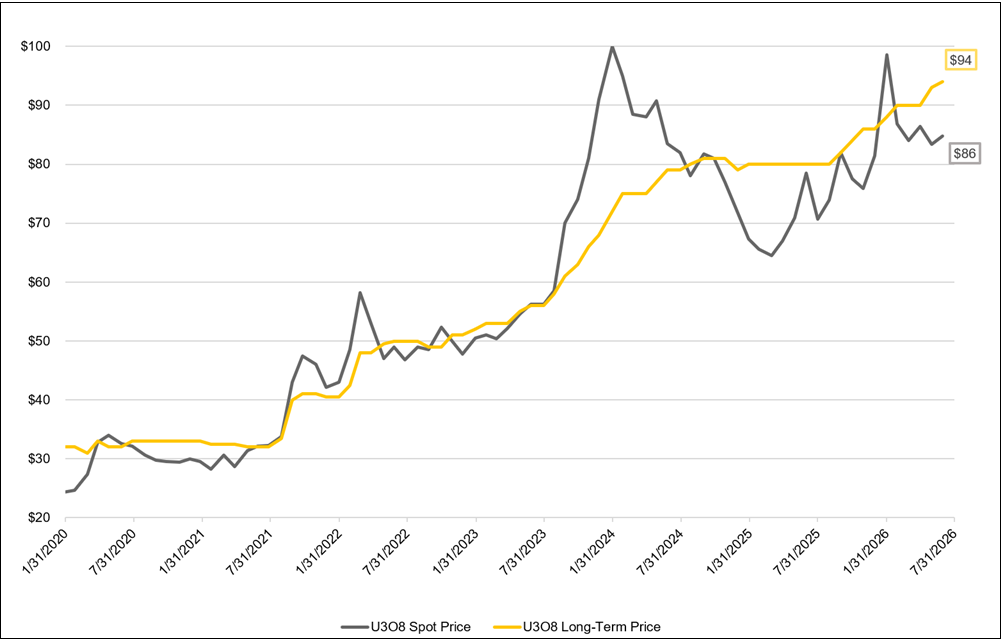
The long-term uranium price has already climbed to $94 per pound, its highest level in 18 years. That price is rising before utilities have returned to the market in force.
Canada will be essential to filling the gap.
Cameco’s Cigar Lake mine can produce 18 million pounds in a year — enough uranium to power Saskatchewan’s electrical grid for 22 years. Cameco has also restarted McArthur River and Key Lake, while Denison Mines and NexGen Energy are advancing two major new Saskatchewan mines.
Yet even these enormous projects require years of permitting, financing, construction, and development.
Demand can arrive with the signing of a data center contract.
New mine supply cannot.
Where the Biggest Gains Can Happen
We have seen this setup before.
During the last major uranium cycle, the uranium price rose from roughly $10 per pound to $136.
Energy Fuels gained 13,275%.
Laramide Resources gained 30,800%.
Paladin Energy gained 130,400% — enough to turn a $1,000 stake into more than $1.3 million.
The forces gathering today are larger than anything the sector faced during the previous cycle.
We now have a structural supply deficit, aggressive government intervention, a worldwide reactor buildout, and Big Tech entering the market as a completely new class of power buyer.
The nuclear renaissance has reached Wall Street.
The uranium contracting cycle is approaching.
And the Third Convergence Event has already begun.
Click here to see The $10 Trillion Energy Stone that’s behind this convergence now, along with the three uranium investments I believe are best positioned for what comes next.
Let's get it,

Gerardo Del Real
Editor, Bizarro World