Gerardo Del Real,
Editor
May 27, 2026
There’s a war going on that will determine a lot about what the future looks like.
Not the one with Iran — although, for obvious reasons (human life, debt levels, emerging and fracturing alliances), that one is very consequential as well.
I’m talking about the war to secure the critical metals that are shaping today — and will shape the future.
China continues to weaponize its critical metals dominance despite the recent summit between President Xi Jinping and President Donald Trump.
China controls about 60% of the world’s mined output and nearly all of the mineral processing capacity in the rare earths space, and it has not been shy about restricting exports as a matter of policy.
Last year, it imposed export restrictions on seven rare earth elements, related compounds, and magnets before extending that to an additional five elements and broadening licensing requirements to cover products made with Chinese-sourced materials or technologies.
The heavy rare earths, in particular, have been a source of contention as they are essential to national security. The heavy rare earths — and the magnets made from them — are used in everything from missiles to defense systems.
Yttrium, used by the aerospace and semiconductor sectors, is up fifteenfold since Chinese export controls began.
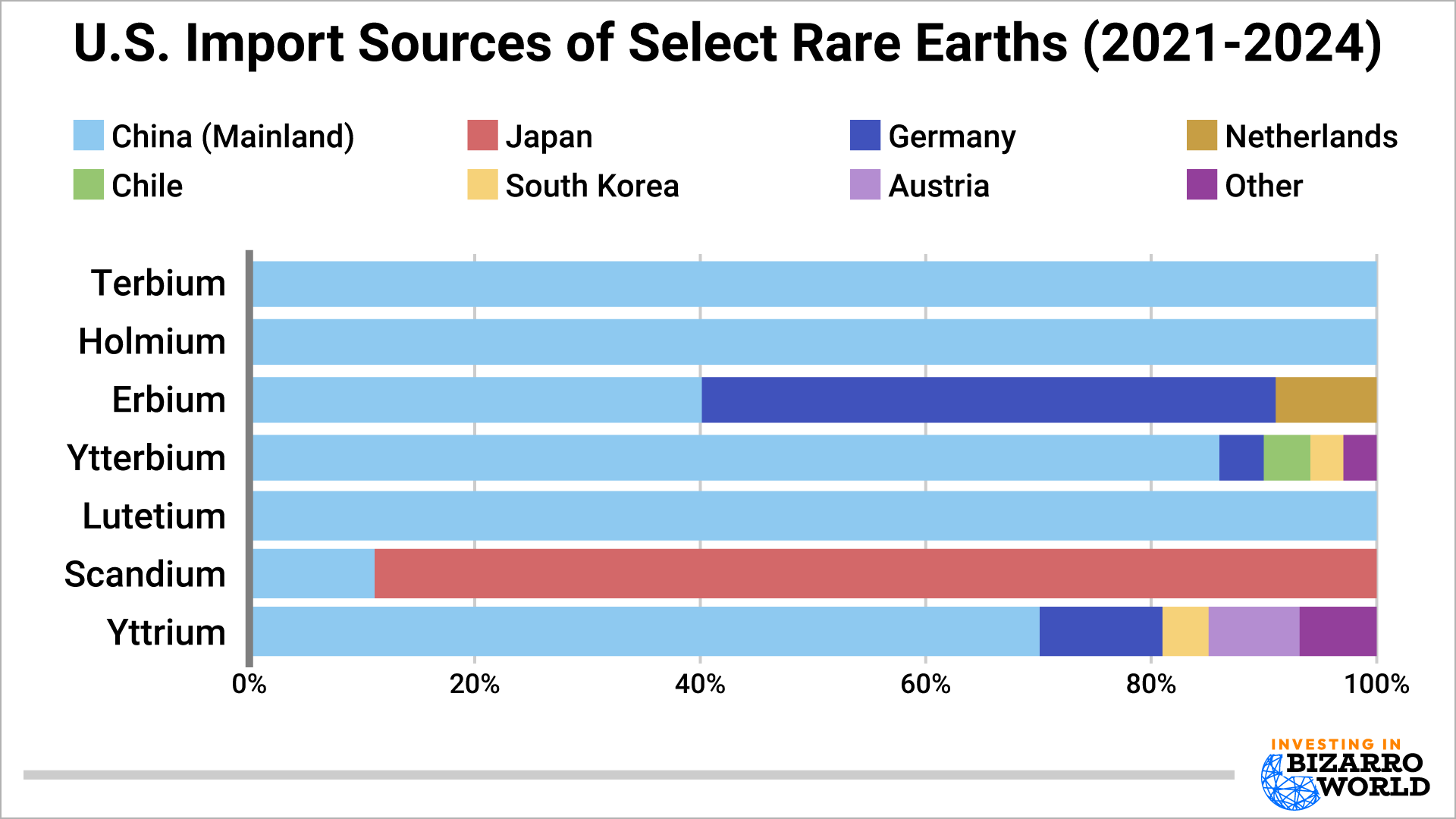
In response, the U.S. has launched a Strategic Critical Minerals Reserve, also known as Project Vault. This public-private partnership, backed by $10 billion in Export-Import Bank of the United States (EXIM) financing, aims to store 60 critical minerals for civilian industries to strengthen industrial resilience and economic security during supply chain disruptions.
The money is already finding a home. Long-time portfolio favorite Perpetua Resources (TSX: PPTA)(NASDAQ: PPTA) secured a US$2.9 billion loan from the U.S. Export-Import Bank (EXIM) to fund construction of the Stibnite Gold Project in Idaho, the country’s only planned domestic source of antimony.
Combined with the company’s existing cash, the federal loan fully covers the estimated capital costs to build the mine. While it’s the gold that is the main driver of value at Stibnite, it’s the project’s strategic value and antimony reserves that led to the loan being secured.
This is far from a one-off. The same is happening in uranium. There are also calls to set price floors for lithium, while recent deals with Mexico focused on greater cooperation in the critical metals space (including silver) highlight the urgency.
Which is why Nick Hodge and I have been hitting the road sourcing projects here in America that can help provide the stuff needed to make the stuff.
Think of it as our own metals vault.
I’m putting together a brand new report that features companies with the opportunity to provide the gold, silver, lithium, and uranium (among other metals) of the future.
Companies that can deliver new discoveries and future supply of these critical metals are going to outperform in this critical metals supercycle.
I’m going to make sure I’m positioned once again to take advantage of this generational opportunity.
Let's get it,

Gerardo Del Real
Editor, Bizarro World