Nick Hodge,
Publisher
July 13, 2026
I recently sat down for an interview at the Rule Symposium to talk about gold, copper, private placements, and the state of the resource markets.
But one part of the conversation stood out.
Uranium.
Not because uranium stocks have been flying.
Quite the opposite.
Many uranium equities have pulled back from their highs. Some have drifted lower even as the long-term uranium contract price has continued to rise.
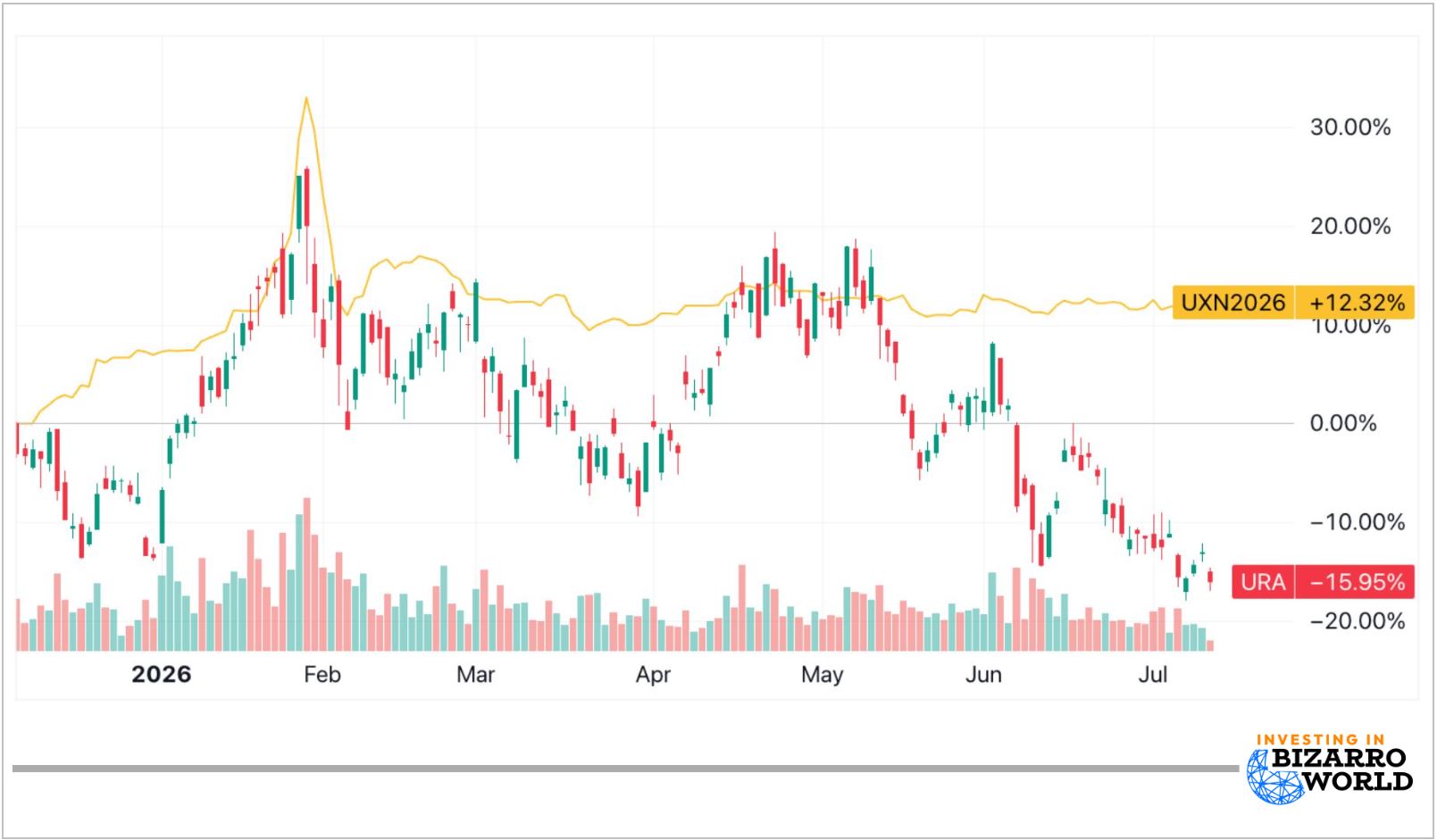
Since late last year, uranium prices (UXN) are up ~12% while the Global X Uranium ETF (NYSE: URA) is down ~15%.
That has frustrated investors.
It has also created an opportunity.
Because while uranium stocks have been soft, the fundamental case for nuclear power has rarely been stronger.
For more than a decade after Fukushima, the nuclear industry was forced to heal its wounds.
Governments shut reactors. Utilities delayed projects. Investors fled the sector. Nuclear companies went bankrupt or survived on scraps.
That era is over.
Japan is restarting reactors and considering new ones.
Existing plants are having their operating lives extended — even in places such as California and New York, where political opposition to nuclear power was once deeply entrenched.
Technology companies are partnering with utilities to restart idled plants because artificial intelligence and data centers require vast amounts of reliable electricity.
And the federal government is no longer merely talking about nuclear energy.
It is putting real money behind it.
The Department of Energy recently announced a plan to provide up to $17.5 billion in low-cost federal loans to help utilities order components for as many as 10 new Westinghouse AP1000 reactors.
That’s not a research grant. It’s not another government study.
It’s an attempt to revive the industrial supply chain required to build large-scale nuclear reactors in the United States.
And it addresses one of the biggest problems the nuclear industry has faced.
Everyone knows we need more electricity.
Everyone knows nuclear power can provide reliable, around-the-clock baseload power without carbon emissions.
But nobody wants to be the first utility to commit billions of dollars to a reactor that might take longer and cost more than expected.
It is the nuclear version of the chicken-and-egg problem.
Utilities do not want to order expensive components until they know a reactor will be built.
Manufacturers do not want to expand production until they know utilities will place orders.
And investors do not want to take the risk unless somebody else agrees to absorb part of it.
The federal government is now stepping in to break that stalemate.
Under the proposed structure, utilities and Westinghouse would contribute some of their own capital, while the government would backstop billions of dollars in financing.
The Energy Department says seven utilities have already submitted formal letters of intent.
There are still enormous hurdles.
Nuclear plants remain expensive. They remain difficult to build. The two AP1000 reactors recently completed at Georgia’s Vogtle plant took roughly 15 years and cost far more than originally projected.
But that is exactly why the new financing matters.
The government is not pretending those risks do not exist.
It’s trying to make them manageable enough that somebody finally places the first order.
That’s how industries restart.
The World Has Become Rational
The change in attitude is showing up in the capital markets, too.
Holtec International, one of America’s largest nuclear equipment and services companies, is preparing to pursue a public listing.
Holtec first considered going public in 2011.
Then Fukushima happened.
Wall Street bankers effectively told the company it would have to shake a tin can to raise money.
Fifteen years later, Holtec’s founder says the world has finally become rational about nuclear power.
The company is working to restart the Palisades nuclear plant in Michigan and has ambitions to develop and operate a fleet of small modular reactors.
It is seeking public capital because the market now understands something it refused to acknowledge for years:
The world needs substantially more electricity, and wind and solar alone are not going to provide it.
Even fusion companies are reaching the public markets.
Jeff Bezos-backed General Fusion (NASDAQ: GFUZ) recently became the first publicly listed pure-play fusion company.
Fusion does not create demand for uranium. It’s a different technology and remains far from proven as a commercial source of electricity.
But its arrival in the public markets tells us something important.
Investors are once again willing to fund nuclear technologies.
Money is moving into reactor development, fuel production, nuclear services, supply chains, uranium mining, enrichment, and advanced fuels.
The entire nuclear ecosystem is being rebuilt.
This Isn’t Just an Electricity Story
Artificial intelligence gets most of the headlines.
And for good reason.
The major technology companies are spending hundreds of billions of dollars building data centers and the infrastructure needed to power them.
Those facilities require enormous quantities of electricity.
They also need electricity that is available whether the sun is shining or the wind is blowing.
But AI is only the most visible source of demand.
The United States is also trying to reshore manufacturing.
Transportation is becoming more electrified. Developing countries are consuming more energy. Older coal plants are being retired. Existing nuclear plants are aging.
And electricity demand is rising after years in which utilities assumed it would remain relatively flat.
We are asking the grid to do more at the same time we are removing some of its most dependable sources of power.
Something has to fill the gap.
Natural gas will supply part of it.
Nuclear will have to supply another.
And nuclear reactors need uranium.
The Stocks Have Been Soft. The Fundamentals Haven’t.
This is the disconnect investors should pay attention to.
Uranium equities have pulled back.
Yet long-term contract prices remain strong.
Governments are extending the lives of existing reactors. Utilities are restarting plants that were supposed to be permanently closed.
New reactor programs are being financed. Domestic uranium production is returning.
The United States is attempting to rebuild its nuclear fuel supply chain.
And advanced reactors will require new types of enriched uranium and specialized nuclear fuels.
In other words, this is no longer simply a bet on uranium explorers finding pounds in the ground.
There are opportunities across the entire fuel cycle:
- Mining;
- Conversion;
- Enrichment;
- Advanced fuels;
- Reactor technology; and
- Nuclear services.
That does not mean every uranium stock will rise.
It certainly does not mean every company promoting a nuclear angle deserves your money.
A strong commodity thesis can still be ruined by bad management, excessive dilution, weak projects, or inflated valuations.
But the broad setup is becoming difficult to ignore.
The industry spent more than a decade recovering from Fukushima.
It now has political support, industrial demand, government financing, rising electricity consumption, and renewed access to capital.
Yet many of the related equities are trading below their recent highs.
That is normally the kind of setup resource investors claim they are waiting for.
The problem is that when it finally arrives, it rarely feels comfortable.
The stocks look weak. The headlines are mixed.
The payoff appears to be somewhere in the future.
That is why the best opportunities are often missed.
As I said during the interview, uranium may not require more patience before acting.
It may require investors to act now — and then have the patience to let the thesis pay off.
My partner Gerardo Del Real has been studying the uranium market, the supply deficit, and the junior companies positioned to benefit as this nuclear buildout accelerates.
He has put together a Junior Resource Monthly presentation explaining where he sees the opportunity — and how investors can position themselves before the uranium equities catch up with the nuclear fundamentals.
Click here to discover the uranium opportunity.
Because the world may finally have become rational about nuclear power.
The stock market just hasn’t fully priced it in yet.
Call it like you see it,

Nick Hodge
Publisher, Bizarro World