Gerardo Del Real,
Editor
July 29, 2026
It’s Fed day today.
The war with Iran is once again escalating.
Oil prices have surged over 7% today alone.
Gold is fighting to hold the $4,000/oz level with the dollar index above 101, currently sitting at 101.5, and the 10-year Treasury yield well above the 4.50% mark at 4.65%.
I told you a few weeks ago that something had to give.
In South Korea, the KOSPI is now down 40% from recent highs in June while triggering multiple circuit breakers seemingly every day this past week.
In fact, it’s the ninth time this year that South Korea's stock market has triggered circuit breakers, and the first time in KOSPI's history they’ve been triggered for two consecutive trading days.
Despite the very loud noise, it’s important to keep an eye on what won’t change despite the volatility.
What won’t change are debt levels (at least not to the downside) and structural deficits. Those are here to stay and will be for years.
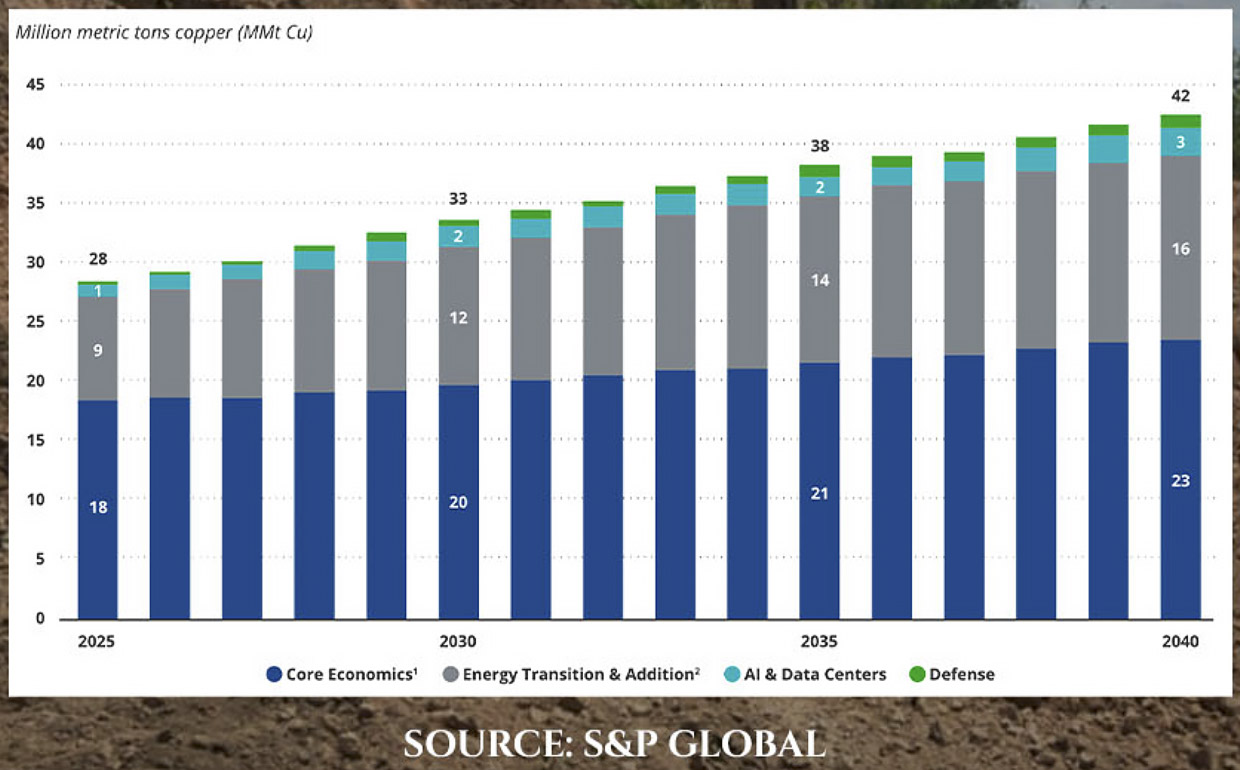
Think about this. Copper demand is expected to grow 50% from 28 million metric tons per year in 2025 to 42 million metric tons by 2040.
New mine supply takes 15 to 20 years from discovery to production. Mines and discoveries aren’t going to magically factor into the supply side of the equation and it’s not getting easier.
Chile, the world’s largest exporter of copper, just saw a 15% to 20% drop in copper production year-on-year.
Codelco’s chairman said the Chilean miner faces another difficult production year and ruled out returning to pre-pandemic output by the end of the decade. A recovery plan will focus on profitability instead of maximizing volumes.
Output at BHP-controlled (ASX: BHP) Escondida fell 17.6% to 108,800 tons, while production at the Collahuasi mine dropped 19.3% to 31,000 tons.
The result will be much higher prices, and the companies that make the discoveries and provide some supply will command a premium.
Rick Rule was interviewed recently, and he highlighted that of 239 major copper discoveries since 1990, 148 are not in production, 121 haven’t completed feasibility studies, and only 15 have finalized construction plans.
Meanwhile, 4 of the top 11 producing mines have been operating for 51 to 152 years. Two have been in production for 25 years or less.
It’s going to take years to even begin to address the shortages materializing right now.
That presents a lot of opportunities. Opportunities that are going to make fortunes.
Let's get it,

Gerardo Del Real
Editor, Bizarro World