Mike Fagan,
Editor
Aug. 14, 2026
I spend a lot of my week reading about markets… and somewhere along the way, I stopped being surprised by much of anything.
But every once in a while, something makes me stop and appreciate just how strange the whole exercise has become.
That’s essentially the premise behind Investing in Bizarro World, where every week Nick Hodge and Gerardo Del Real sit down and attempt to make sense of the markets — and all the increasingly bizarre things influencing them.
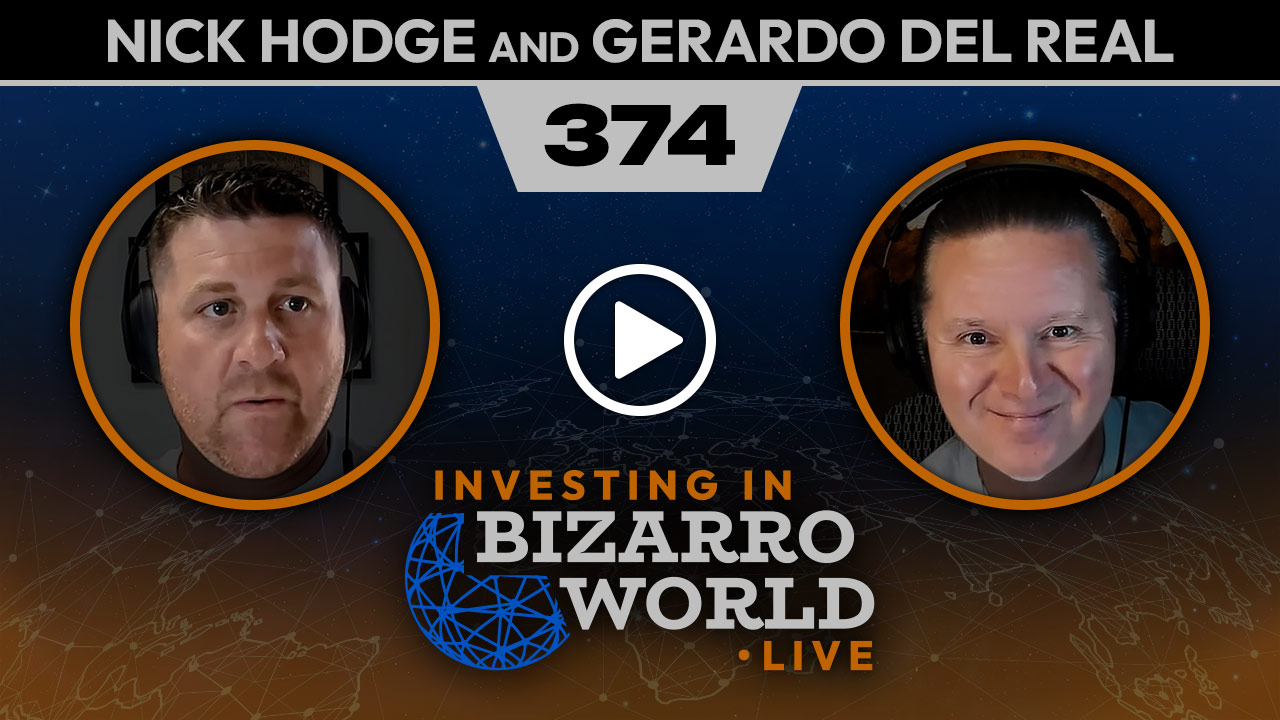
Gerardo calls it their “weekly therapy session.”
Turns out, that may be less of a joke and more of an actual diagnosis.
On a recent episode, Nick was looking at Treasury yields, the dollar, gold, and some of the traditional market correlations that suddenly weren’t behaving very traditionally.
After trying to make sense of it all, he finally offered perhaps the most accurate market analysis I’ve heard in a while:
“The market doesn’t even know what the hell is going on.”
Fair enough.
And perhaps it’s time to just stop making sense.
Nick, however, had other ideas.
He pulled up the charts and started working through what was actually happening — the dollar, gold, Treasury yields, and the rotation of capital beneath the surface of the broader market.
That’s the part of Bizarro World I find most interesting.
It’s easy to point out that things are weird.
The trick is figuring out what to do about it.
Boring Can Be Good
Take uranium.
Gerardo recently described it as the friend who shows up to every party dressed exactly the same.
Week after week, there it is. Roughly the same spot price. Roughly the same long-term contracting price. Not exactly the life of the party.
I’ve known a few people like that. Come to think of it, I may be one of them.
But beneath the joke was a serious point.
Nuclear power demand is growing, utilities need to secure long-term uranium supply, and massive AI and data-center buildouts are adding another source of future electricity demand.
Meanwhile, uranium equities have been pretty boring themselves.
Nick and Gerardo don’t necessarily see that as a bad thing. They see an opportunity to accumulate quality names while much of the market isn’t paying attention.
Sometimes boring isn’t a reason to leave.
Sometimes it’s the reason to start paying attention.
The Strip Club Indicator
Then there’s Gerardo’s own personal inflation index.
Strip clubs!
Now, I can’t quite remember everything we covered way back in Economics 101… but I’m pretty sure the price of a lap dance wasn’t one of the leading economic indicators we studied (at least not in class!).
Maybe I was taking all the wrong courses.
Gerardo, however, swears there’s some serious science behind it.
His theory is that the ever-gyrating price of a lap dance tells you something about the level of disposable money floating around the economy at any given time.
And you know what… I’m more than willing to check that theory out for myself!
In fact, I’m starting to think the Fed could save us all a lot of time and money by skipping the CPI report and simply sending me, Nick, and Gerardo to the nearest gentlemen’s club with a clipboard.
For research purposes, obviously.
But the conversation quickly turned serious.
When a listener asked Gerardo what her husband should do after making a 5-bagger on a particular stock, Gerardo didn’t tell him to sell. He didn’t tell him to hold, either.
He said the answer depended on what kind of investor he was. Could he take profits and live with watching the stock double again without him? Or could he hold through a huge drawdown because he still believed in the thesis?
That’s a deceptively important question.
There isn’t one correct way to take profits because there isn’t one type of investor. You need to know which one you are before the market decides to find out for you.
What Do You Do About It?
That eventually gets to the heart of Nick and Gerardo’s approach.
They don’t try to own everything. They develop a thesis, tap their deep Rolodex to vet companies, and, as Gerardo puts it, try to “make our positions count.”
Nick recently talked about taking profits from a couple of portfolio positions and building cash so he could deploy it into longer-term opportunities. Gerardo talked about learning the hard way why he no longer trades on margin, sharing a lesson listeners can apply to their own portfolios.
None of that is particularly flashy.
Take profits. Keep some cash. Know your risk tolerance. Wait for opportunities. Put meaningful money behind your strongest ideas.
But that’s precisely the point.
Bizarro World is entertaining because the world is absurd. Nick and Gerardo aren’t there merely to point and laugh at it.
Every week, they’re trying to figure out how to invest through it.
And eventually the conversation gets down to specific investment ideas. That’s where things get particularly interesting.
Right now, there’s a special offer to join Investing in Bizarro World Premium and get access to the part of the conversation where Nick and Gerardo start talking specific portfolio picks.
Because if we’re really going to live in a world where the lap dance is a key economic indicator… uranium is the boring guy at the party… and the market itself admits it has no idea what the hell is going on — we might as well try and make some money from it.
Click here to test-drive Investing in Bizarro World Premium — because this much insanity ought to be good for something.
Yours in profits,

Mike Fagan
Editor, Bizarro World