Nick Hodge,
Publisher
June 30, 2026
Gold is in the shitter.
And it’s got my contrarian blood bubbling.
I’ll tell you what I bought more of today in a second. First, some context.
The on-again / off-again war in Iran is creating global uncertainty. When capital is uncertain, it flees to US dollars.
As a result, the US Dollar Currency Index hit highs last week that haven’t been seen in more than a year.
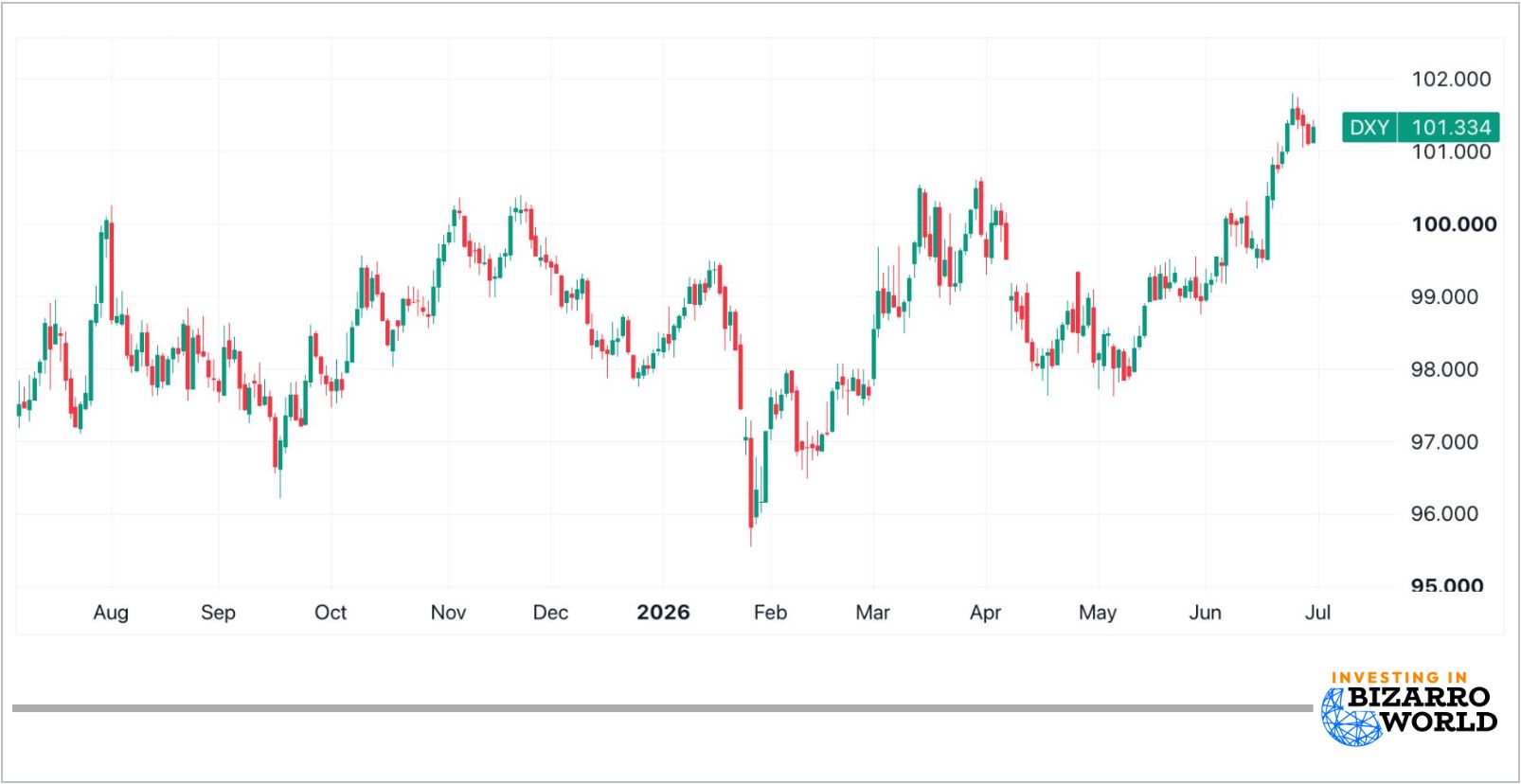
When the dollar index goes up, things that are priced in dollars go down. That includes Bitcoin and Space Exploration and, yes, gold.
The gold chart has broken down as a result. It broke down below its trendline at $4,170. It pierced the big round psychological level of $4,000, where it's currently fighting for its life. If it doesn’t hold there, next stop is $3,930. And if that doesn’t hold, the knife will ultimately hit the floor somewhere between $3,200 and $3,400.
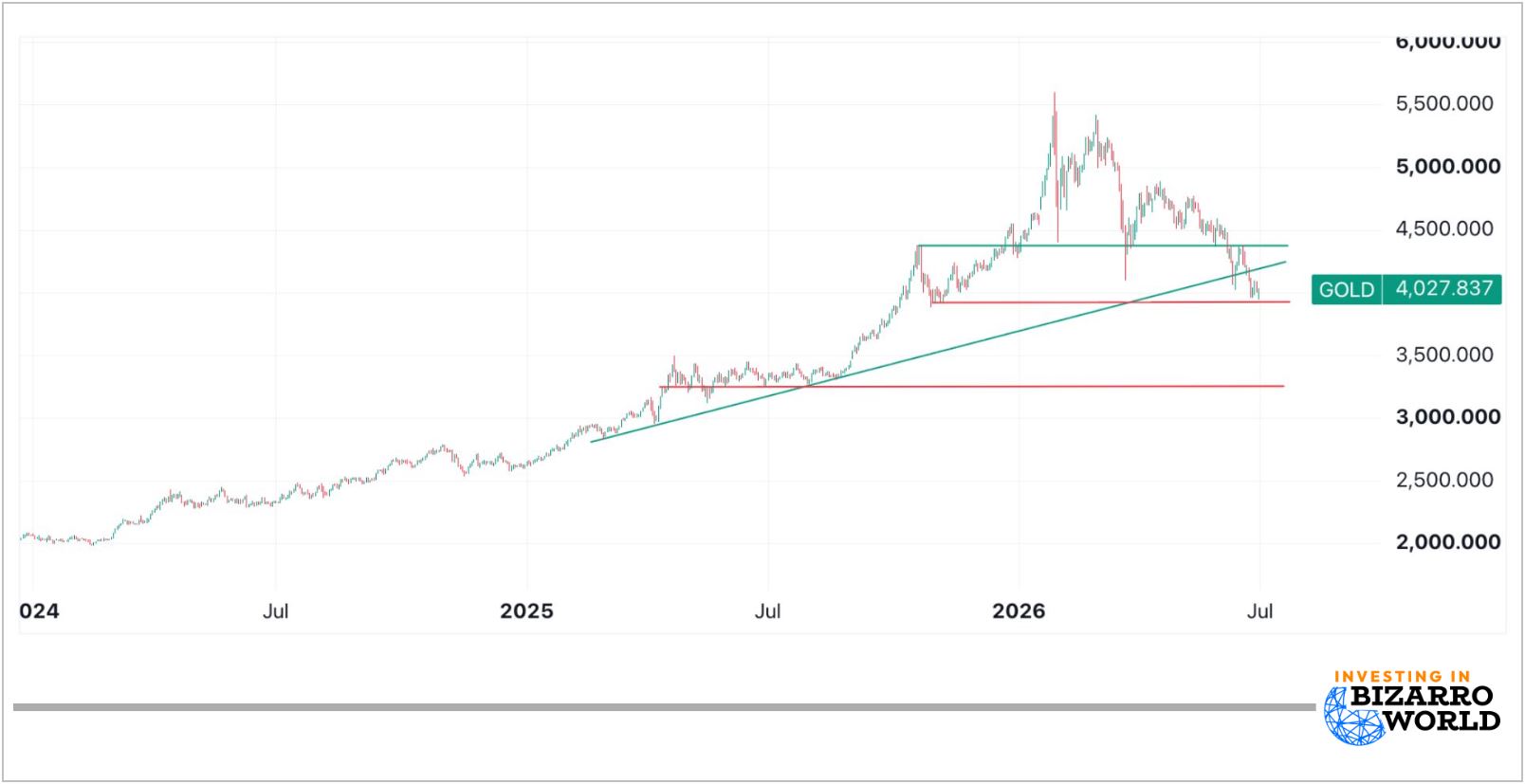
Here’s the thing…
Even if that complete breakdown occurs, gold will still be at a price that no one on this Earth has seen for the past two millennia. At $3,400, gold would still be more than twice the price of the average all-in sustaining costs of the world’s top miners, which is about $1,600 per ounce.
Gold miners would still be printing money. And that’s a worst-case scenario.
At current valuations, gold miners are historically cheap.
Scotiabank put out a note in June that analyzed gold stocks going back to the 1970s on four metrics: Free Cash Flow (FCF) Yield, EV/EBITDA (Enterprise Value to Earnings Before Interest, Taxes, Depreciation, and Amortization), price-to-cash flow (P/CF) ratio, and P/NAV (Price to Net Asset Value).
Their conclusion?
“The gold equities are trading at very attractive valuations on these 4 metrics (at spot gold commodity prices) versus historical levels.”
And on a risk-adjusted basis, these Gold Script companies really stand out.
They are the companies that have streaming and royalty agreements on existing gold mines.
A miner has to dig the gold out of the ground. That means labor, diesel, steel, explosives, equipment, permitting, sustaining capital, cost inflation, and operational headaches.
A royalty or streaming company usually does not run the mine. It writes a check upfront, and in exchange it gets either:
- A royalty: a small cut of revenue from the mine; or
- A stream: the right to buy some gold or silver from the mine at a fixed low price.
So when gold is high, the royalty company benefits from the high gold price, but it does not take on most of the rising mine-cost problem.
That is the key point in simple terms:
Miners make more money when gold rises, but their costs can rise too. Royalty companies make more money when gold rises, while their cost base stays relatively light.
At high gold prices — whether they are $4,000 or $3,400 — these Gold Script companies are like toll booths on gold mines.
They collect a piece of the traffic without paying to maintain the whole road.
And that’s why I bought more of a leading Gold Script company this morning.
You can check out the full thesis here, including why the entire sector could take back off as soon as this coming July Fourth weekend.
Call it like you see it,

Nick Hodge
Publisher, Bizarro World