Nick Hodge,
Publisher
Sept. 15, 2026
Throughout August, gold became less concerned with bond yields and more responsive to the dollar.
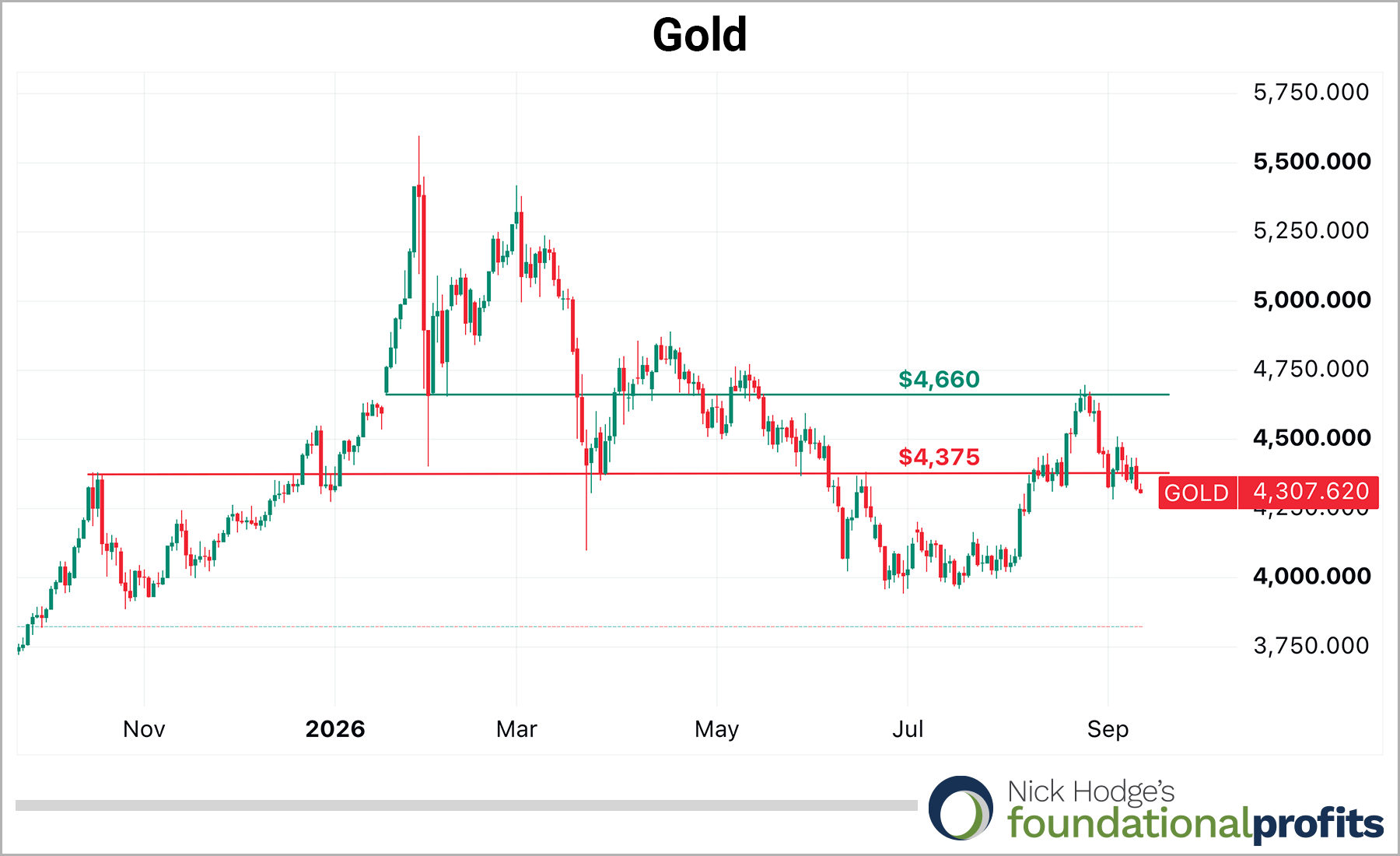
In last month’s issue of Foundational Profits, I told members that “$4,375 was resistance, then support, and then back to resistance. Gold is now back above that level and looking like it wants to test the next level up, near $4,660.”
A weaker greenback helped it reclaim $4,375 and rally toward that $4,660 level.
That relationship has changed again.
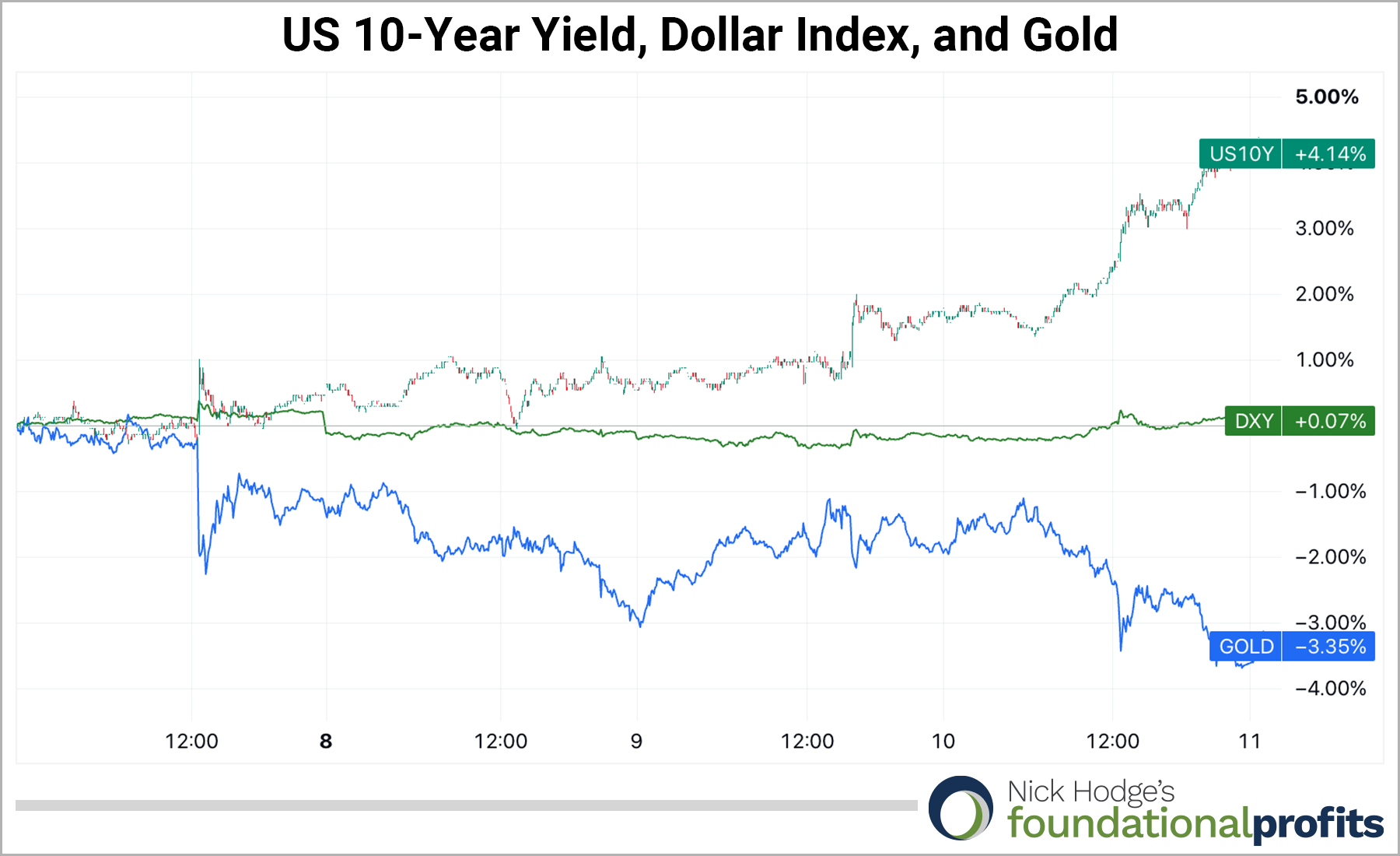
Over the past week, gold has fallen roughly 3.2% while the Dollar Index has been essentially flat. Meanwhile, the 10-year Treasury yield has climbed toward 5%.
My read is that gold is once again taking its immediate cue from rising yields. Higher yields make bonds more competitive with a metal that pays no interest, particularly when investors expect further Fed tightening.
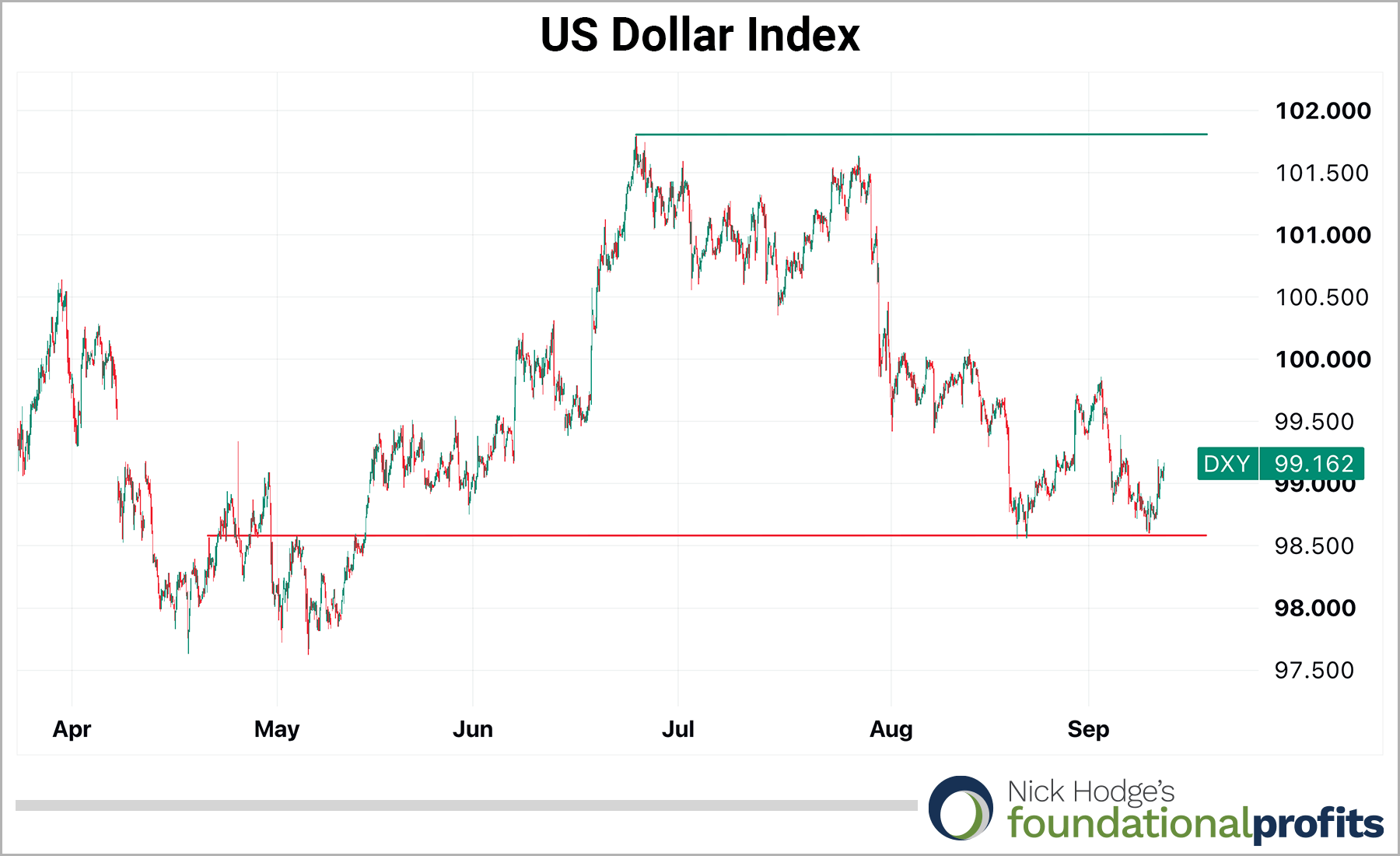
The dollar remains weak on the broader chart, around 99. Support is near 98.5, while June’s high around 101.8 remains the larger hurdle for a bullish reversal. For now, dollar weakness simply hasn’t been enough to overcome the rate headwind.
But a week’s trading doesn’t settle a multiyear investment thesis. This renewed sensitivity to rates could prove temporary. A pause in rising yields could give gold room to respond again to the weaker dollar and its longer-term drivers.
Writing in the Financial Times, UBS chief strategist Bhanu Baweja makes the case that gold’s old relationship with real, or inflation-adjusted, yields has fundamentally changed since 2022. Between March 2022 and October 2023, U.S. five-year real yields rose more than four percentage points. Gold nevertheless gained 7%.
Years of deficit spending, pandemic stimulus and loose monetary policy helped create the enormous debt burdens and inflation we’re dealing with today. Higher rates then make those debts more expensive to service. That increases political pressure to contain borrowing costs, even before inflation has been fully defeated.
Baweja sees early signs of fiscal dominance: the government’s financing needs increasingly shaping monetary policy. The Fed could raise rates first and face pressure to cut them aggressively later. Investors also want more compensation for the uncertainty of holding long-term government debt. Both concerns can strengthen demand for gold.
The very fiscal excesses helping create today’s rate problem remain central to the long-term gold thesis. A higher Treasury yield doesn’t suddenly give Washington spending discipline.
Central banks are making their own calculations. The freezing of Russia’s foreign reserves in 2022 demonstrated the political risks attached to sovereign financial assets, accelerating efforts to diversify into gold. Meanwhile, periods when stocks and bonds fall together have encouraged private investors to seek another portfolio hedge.
And large money managers have been buying the retreat.
Bloomberg reported on September 4 that Amundi, Pictet, Robeco and Fidelity International had rebuilt gold holdings reduced earlier this year. Across interviews with more than a dozen managers whose firms oversee a combined $27 trillion, every one had either added gold in recent weeks or maintained bullish allocations.
Amundi anticipated a return to $5,000 by year-end, although it wanted greater clarity on Fed policy before adding further. That captures the tension well: confidence in gold’s longer-term role alongside respect for the immediate interest-rate risk. These purchases preceded this week’s latest decline, but they demonstrate institutional demand during the broader correction.
Technically, gold is now around $4,300. The first repair requires reclaiming and holding $4,375–$4,380. Above that, $4,660 remains the next recovery level, followed by the more substantial resistance near $4,780.
On the downside, there’s thin support at $4,240, but if that rope snaps we’d likely see $4,000 in short order. Gold repeatedly found buyers at that level during June and July. Holding that base would preserve the broader bullish setup through another correction while a decisive break below it would materially weaken the chart and require reassessment.
I remain constructive on gold over the longer term.
The debt, deficit and purchasing-power concerns underpinning this bull market remain unresolved.
Over the coming weeks, though, I want to see bond yields stabilize and gold recover its lost support before declaring this pullback finished.
Editor’s Note: You just read a portion of the September issue of Foundational Profits. We have closed over 412% cumulative gains in the precious metals space this year, including 182% on the sale of the Sprott Silver Miners & Physical Silver ETF and 194% on the sale of the VanEck Junior Gold Miners ETF. Click here to see how that publication focuses on long-term market trends and positioning with a contrarian perspective that has often outpaced the return of the S&P 500.
Call it like you see it,

Nick Hodge
Publisher, Bizarro World