Nick Hodge,
Publisher
Nov. 24, 2026
The end of the year quickly approaches.
And so does the end of recent healthy inflation and economic growth.
Both are set to slow and, coupled with the tightening of credit that underpinned tech expansion, will let some air out of a stock market that was just at record highs last month.
Election-elevated volatility catalyzed a sell-off to start the month that took the S&P 500 down nearly 6% from its October peak.
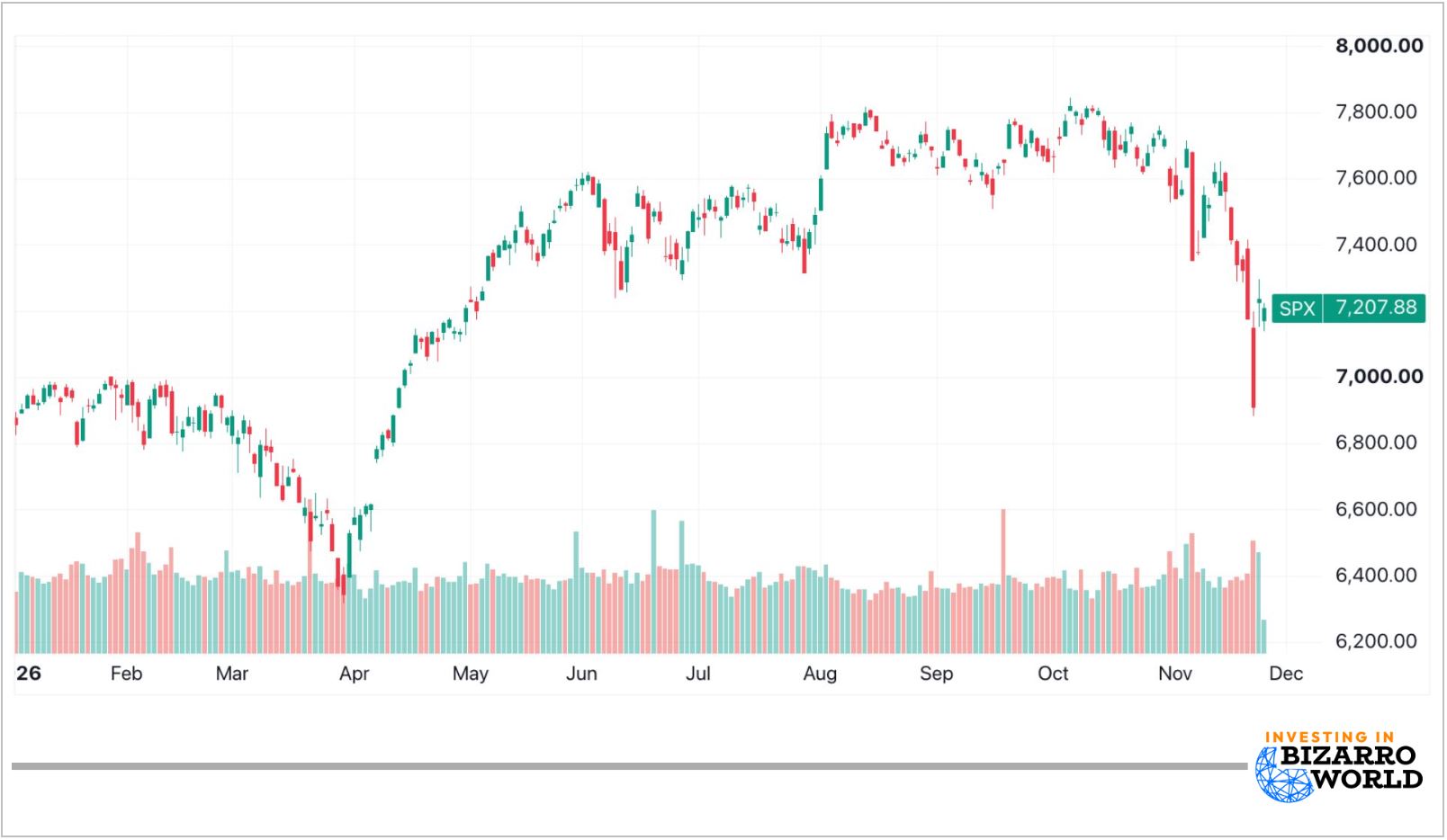
Though it’s now recovered a bit, the S&P now up just 4.8% for the year. (Investors have been getting used to 17% to 31% annual index returns the past few years, save for 2022.)
The VIX, a measure of expected S&P 500 volatility over the next 30 days, derived from both put and call prices, spiked to its highest level since the beginning of the Iran war.
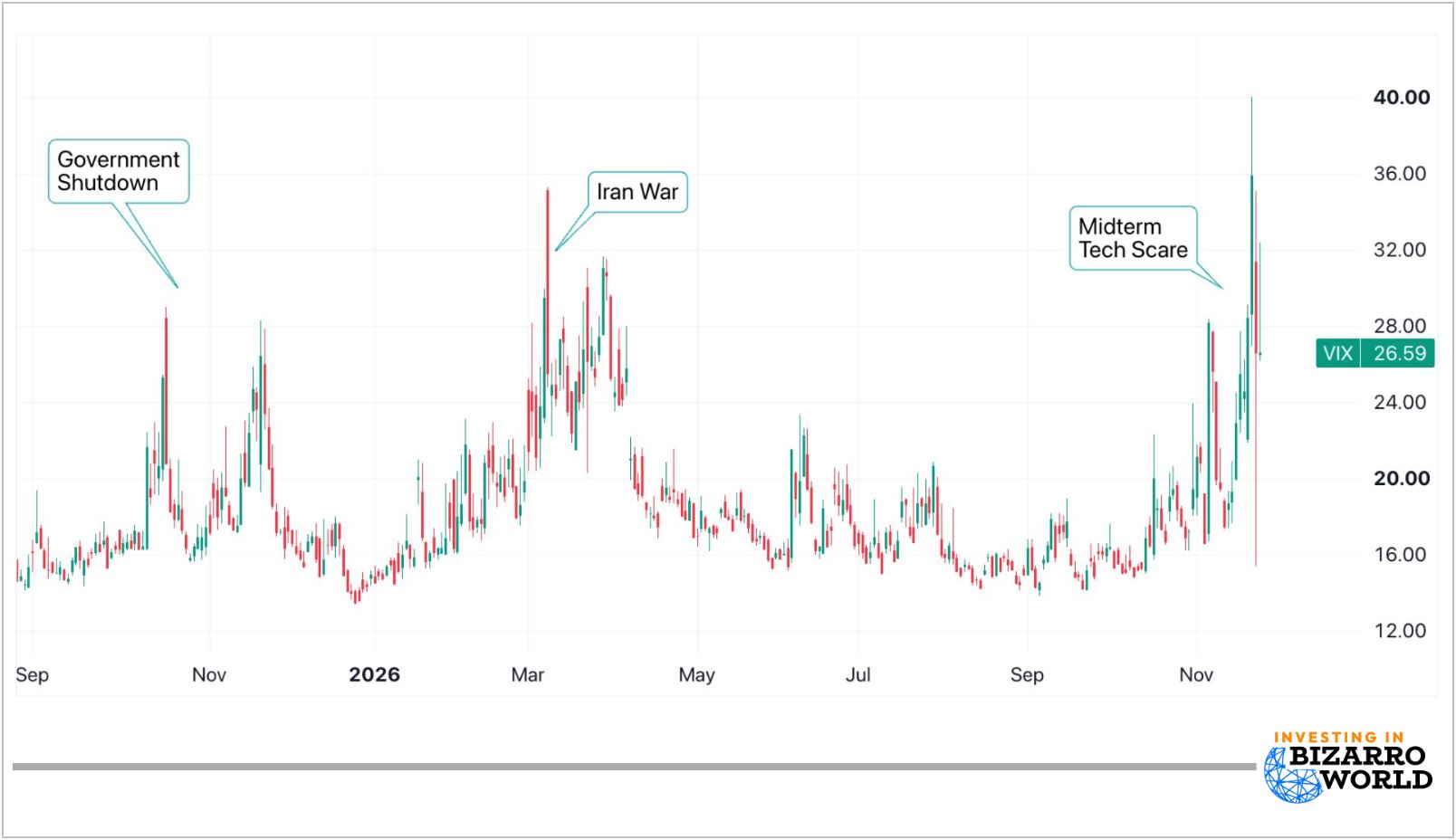
I don’t think investors were scared of slowing tech earnings, Democratic AI pushback, or the implications of Huang’s wandering wang. I think they’re pricing in a coming period of slowing economic growth and inflation both closely tied to the oil market. And I think the Fed is tightening rates into a slowdown that is already underway, which could make for difficult markets heading into 2027.
For oil’s part, after enjoying most of 2025 below $75, WTI quickly shot up to over $100 early this year when the “no more war” president did more war, and has spent the balance of time more above $90 than below it.
That has led to higher prices for consumers at the pump and elsewhere. It’s what led to a change-out of the GOP in the election, and will also lead to a slowdown in GDP growth in the economy.
I told members of Foundational Profits last month that GDP for Q3 would come in “somewhere between 3% and 4%, before slowing down in Q4 2026 and Q1 2027 as high oil prices start to bite.” We just got the first part of that, with Q3 GDP since being reported at 3.4% (annualized).
The current and next quarter will see the biting part, as the jaws of higher prices grind growth down by 100 to 200 basis points — from mid-3% to mid-1%.
Counterintuitively, as we approach the one-year anniversary of higher oil prices, we can celebrate by eating disinflationary cake. As I also told members last month, “on a quarterly basis, we’ll likely see peak inflation this quarter, before declining through the first half of 2027.” And I explained that:
Base effects are part of that outlook. As the strong Iran war-induced price increases of spring 2026 enter the year-earlier comparison, the annual inflation rate becomes easier to bring down. That does not require prices to fall, it just requires them to rise more slowly.
Data compiled from the BLS, BEA, Atlanta Fed, and FactSet have consensus estimates for year-over-year inflation at 3.5% for Q4, 3.13% in Q1 2027, and 2.2% in Q2 2027.
September’s year-over-year inflation rate was 3.74%. October printed 3.95%. It will likely be lower from there.
This is what the bond and stock market started to price in during October. You can see the ten-year yield rolled over in early October, peaking near 5.35% and falling to 4.8% by the first week of November.

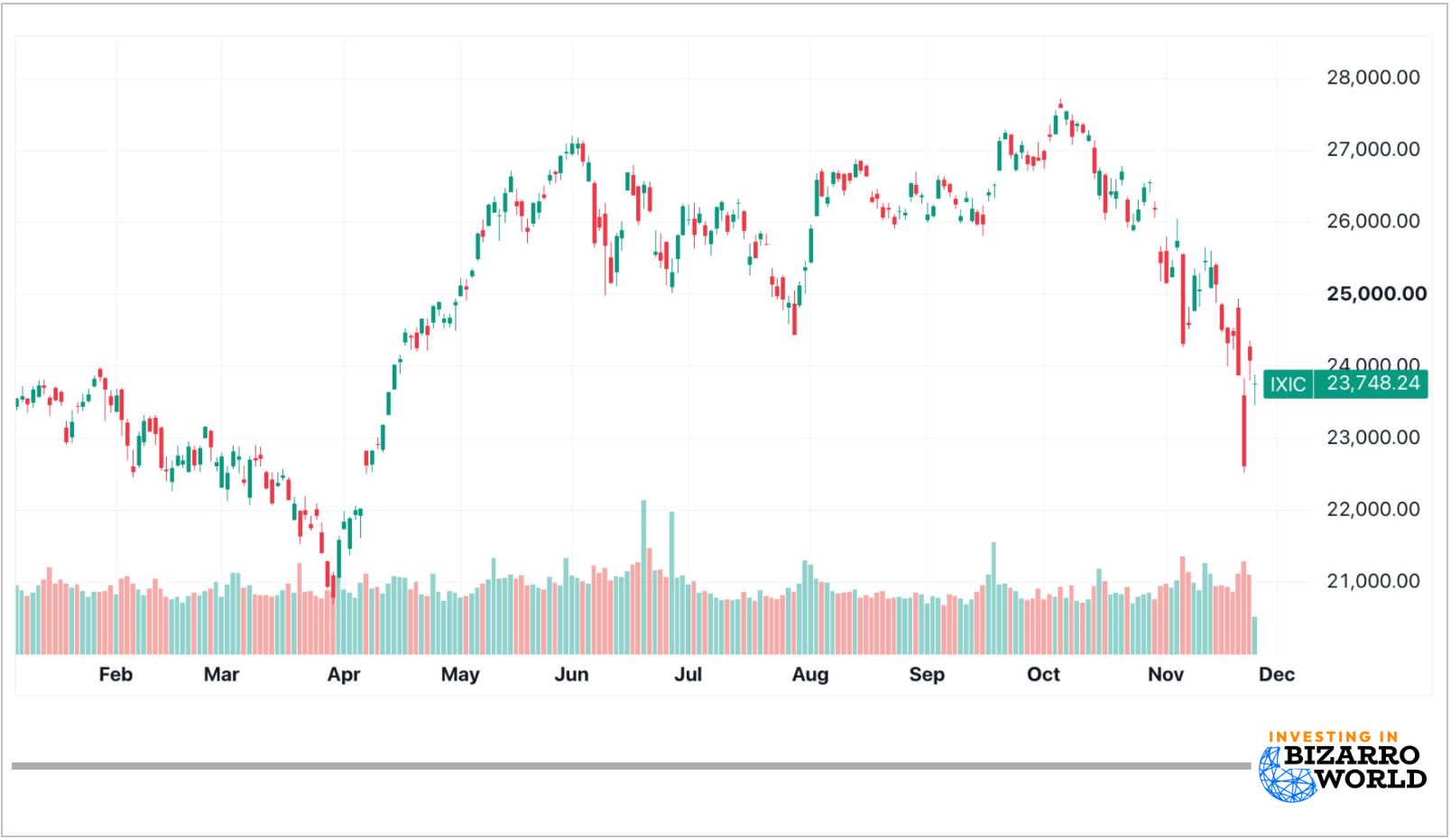
The NASDAQ rolled over the same week, and has since endured an 18% drawdown from its highs, leaving it flat for the year.
The next Federal Reserve meeting is December 9th. It will hike by a quarter point.
It will do that without the benefit of seeing the November inflation number, which prints on December 10th. I expect it to show cooling inflation from the October 3.95% number.
Right now, the market is pricing in two more hikes after that — a quarter-point in January followed by another quarter-point in March.
I’m taking the under on those two hikes in early 2027.
And that’s one of the main reasons I think the countdown to higher gold prices is back on.
Call it like you see it,

Nick Hodge
Publisher, Bizarro World