Nick Hodge,
Publisher
Aug. 18, 2026
BOTZ, ROBO, ROBT and WTAI all promise exposure to artificial intelligence and automation. Under the hood, they own four very different versions of the future.
Most investors who want exposure to the robot revolution will type “robotics ETF” into a search bar, choose the fund whose name sounds closest to the theme, and assume the job is done.
That is convenient. It is also a good way to buy something very different from what you intended.
I recently looked under the hood of four prominent funds offering exposure to artificial intelligence, automation and robotics:
- Global X Robotics & Artificial Intelligence ETF (NASDAQ: BOTZ)
- ROBO Global Robotics & Automation Index ETF (NYSE: ROBO)
- First Trust Nasdaq Artificial Intelligence and Robotics ETF (NASDAQ: ROBT)
- WisdomTree Artificial Intelligence and Innovation Fund (NYSE: WTAI)
Despite the similar names, their portfolios have surprisingly little in common.
BOTZ is heavily concentrated in industrial automation companies. ROBO spreads its capital across a broad collection of robotics applications and enabling technologies. ROBT owns more than 100 companies and leans heavily toward software. WTAI is primarily a bet on semiconductors, memory, cloud infrastructure and the broader AI supply chain.
Even their exposure to Nvidia (NASDAQ: NVDA) varies dramatically. Nvidia currently represents 9.35% of BOTZ and 5.00% of WTAI, but only 1.39% of ROBO and 0.77% of ROBT.
That alone should tell you how little an ETF’s name reveals about what you are actually buying.
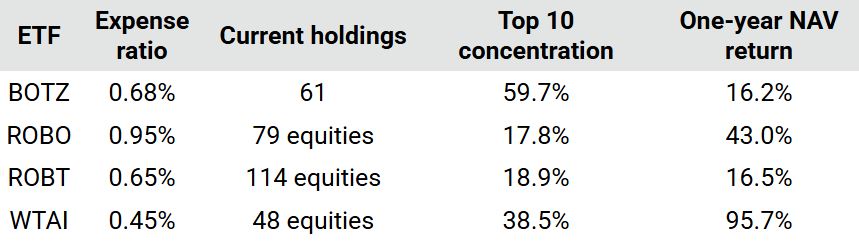
That enormous performance gap does not tell us which fund will do best next. It tells us that these are not interchangeable products. Their results diverged because they owned different companies, placed different weights on them and captured different parts of the AI value chain.
Here is what each fund actually gives you.
BOTZ: The Industrial Automation Bet
BOTZ is probably the closest of the four to a traditional robotics fund.
It tracks an index of companies involved in industrial robotics, factory automation, autonomous systems and artificial intelligence.
Its five largest positions are Keyence, Nvidia, ABB, Fanuc and Intuitive Surgical. Together, they represent approximately 43% of the entire fund.
Keyence makes sensors, machine-vision systems and factory-automation equipment. ABB and Fanuc are industrial-robotics leaders. Intuitive Surgical dominates robotic surgery, while Nvidia supplies much of the computing power increasingly required by autonomous machines.
BOTZ therefore gives you meaningful exposure to the physical infrastructure of automation. The tradeoff is concentration: its ten largest positions represent nearly 60% of the portfolio, so the fund’s performance is driven primarily by a small group of established multinational companies.
If your thesis is that factory automation, machine vision and industrial robotics will continue expanding globally, BOTZ is the clearest expression of that view among these four funds. It is much less diversified than its 61 holdings might initially suggest.
ROBO: The Broadest Robotics Basket
ROBO takes the opposite approach.
Its portfolio is divided between companies applying robotics and automation technology, which represent approximately 55% of the fund, and companies supplying enabling technologies, which account for the other 45%.
That includes industrial automation, logistics, autonomous systems, healthcare robotics, food and agriculture, artificial intelligence, sensing, actuation and 3D printing. Geographically, the fund is also broadly distributed across North America, Asia and Europe.
Its current largest positions include AutoStore, Teradyne, Zebra Technologies, Novanta and Ambarella. Yet none represents even 2% of the fund.
The ten largest positions collectively account for less than 18%.
That makes ROBO the most diversified and arguably the most balanced robotics fund in this group. It also makes it the most expensive, with a 0.95% expense ratio.
ROBO is designed to capture the industry rather than predict its dominant winners. That can reduce company-specific risk, but it also limits the effect of a breakout success. If its largest position doubled while everything else remained unchanged, the gain would add less than two percentage points to the fund.
Diversification works in both directions: it prevents a single failure from wrecking the portfolio, while ensuring that a single winner cannot transform it.
ROBT: More Software Than Robots
ROBT uses a particularly broad definition of artificial intelligence and robotics.
Its index sorts companies into three categories:
- “Engagers” that design, create or deliver AI and robotics products receive 60% of the index.
- “Enablers” supplying components such as semiconductors, machinery and databases receive 25%.
- “Enhancers” using AI to improve products or services that are not primarily AI businesses receive 15%.
The fund then gives relatively similar weights to companies within each category. ROBT currently owns 114 companies.
Its largest positions include Appian, CCC Intelligent Solutions, Oceaneering International, UiPath and Palo Alto Networks. Information technology represents nearly 55% of the portfolio, compared with approximately 21% in industrial companies.
Those holdings are not necessarily what an investor imagines after hearing “artificial intelligence and robotics.” Appian and UiPath are enterprise-automation software companies. Palo Alto Networks sells cybersecurity products, while CCC provides technology to the insurance and automotive industries.
Nvidia, meanwhile, is less than 1% of the fund.
ROBT gives investors broad exposure to businesses that develop, enable or use AI. It is not a concentrated physical-robotics portfolio, and its classification system reaches far beyond companies manufacturing robots.
That may be exactly what some investors want. They should simply understand what they are buying.
WTAI: The AI Infrastructure and Semiconductor Bet
WTAI is the least expensive of the four, with a 0.45% expense ratio, and it has recently been the best performer by a wide margin.
Its current top holdings include Nvidia, Micron, Samsung Electronics, Amazon and Kioxia. Nearly 78.5% of the portfolio sits in information technology, and every underlying equity currently qualifies as a large-cap stock under WisdomTree’s market-cap classifications.
WisdomTree views AI as a stack of bottlenecks extending from power and data centers through semiconductors, memory, networking, cloud platforms and software. Its index committee reviews that stack quarterly and adjusts the portfolio toward the areas where revenue is materializing or supply is constrained.
Today, that means a heavy emphasis on chips, memory and AI infrastructure.
WTAI owns the companies designing processors, manufacturing semiconductors, supplying high-bandwidth memory and building the cloud capacity required to run increasingly powerful AI models. Robotics is one potential source of demand for that infrastructure, but it is only one.
Buying WTAI is primarily a bet that AI capital spending will continue flowing through Nvidia, Micron, Samsung, Broadcom, Taiwan Semiconductor, Oracle and other large technology suppliers. It is not primarily a bet on emerging robot manufacturers.
Its one-year NAV return through June 30 was 95.7%, demonstrating how powerful that positioning became as semiconductor and infrastructure spending accelerated. It also illustrates the volatility that comes with concentrating nearly four-fifths of a fund in technology.
The ETF Is Not the Investment Thesis
I am not arguing that any of these funds is inherently good or bad.
Each serves a legitimate purpose:
BOTZ provides concentrated exposure to established industrial-automation leaders. ROBO owns a broad cross-section of the robotics industry. ROBT captures software companies, technology suppliers and businesses using AI across their operations. WTAI concentrates on the infrastructure supporting the entire AI ecosystem.
The important lesson is that buying “a robotics ETF” is not an investment strategy. Investors must decide which part of the revolution they actually want to own.
There is also a more fundamental limitation.
An ETF is built to own a basket. It cannot concentrate exclusively on the handful of companies that ultimately capture most of the economic value without becoming something other than an ETF.
That matters because technology revolutions never distribute their rewards evenly.
The internet produced thousands of publicly traded companies, but a small number generated most of the lasting wealth. The smartphone revolution created an enormous ecosystem, yet Apple, Google and a handful of semiconductor companies captured a disproportionate share of the profits.
Physical AI and robotics will almost certainly follow the same pattern.
Some robot manufacturers will never achieve economical production. Certain automation companies will lose their technological advantages, while others will issue stock repeatedly to finance years of losses. Software products that appear indispensable today may be bundled into larger platforms or displaced by better models.
The eventual winners could become enormously valuable, but owning every company exposed to the theme guarantees that your portfolio will also include many of the laggards.
Where Human Intelligence Still Matters
This is where Chris Curl and Digital Dispatch take a different approach.
Chris is not trying to own the average robotics company. He has been analyzing individual businesses to identify the companies he believes can emerge as the biggest winners as artificial intelligence moves beyond computer screens and into warehouses, factories, delivery networks and the physical economy.
His selection process looks for real commercial deployments, measurable customer returns, Nvidia investment or technological integration, reasonable valuations and identifiable catalysts over the next 12 to 24 months.
That work has led him to three specific opportunities:
One is an autonomous-delivery company with more than 100,000 completed commercial deliveries, an exclusive relationship with a major delivery platform and direct backing from Nvidia.
Another is a profitable enterprise-automation leader generating more than $1.4 billion in annual revenue, but trading at a valuation that Chris believes fails to recognize its role in the coming physical-AI economy.
The third controls a massive contracted backlog in warehouse automation and has been pressured by execution problems that Chris believes are temporary — potentially creating an attractive entry point before revenue and profitability accelerate.
Instead of dividing your capital among 48, 79 or 114 companies, Chris’s approach allows investors to concentrate on the businesses he expects to benefit most.
That gives a successful recommendation enough weight to make a meaningful difference to your returns.
The arithmetic is unavoidable. If a 1% ETF holding doubles, it adds roughly one percentage point to the fund. A 10% position that doubles contributes approximately ten percentage points, assuming everything else remains unchanged.
ETFs are built to capture a theme. Concentrated research is how an investor attempts to outperform it.
Chris explains the opportunity in a presentation called “Nvidia’s Atlas Initiative.” In it, he reveals one complete robotics recommendation — including the company name, ticker and investment thesis.
His research includes financial analysis, competitive positioning, risk factors and specific buying guidance.
Buying an ETF can be an intelligent way to own the broad revolution.
Using human intelligence to determine which companies deserve the most capital is how you try to capture its biggest winners.
Watch “Nvidia’s Atlas Initiative” and see the companies Chris has identified here.
Call it like you see it,

Nick Hodge
Publisher, Bizarro World