Jimmy Mengel,
Director of Customer Experience
Oct. 9, 2026
“Only those who will risk going too far can possibly find out how far one can go.”
Harry Crosby, Transit of Venus
A murderer’s row of the artificial intelligence community descended upon the White House last month to plead their case to President Trump to either set some safety boundaries or leave them alone.
The event was billed as an “extraordinary gathering" of the minds that are "building America's Golden Age". The guest list included an all-star team of leaders from the industry: OpenAI, Anthropic, Nvidia, SpaceX, Meta and Google were all in the lineup.
At a time where AI research is breeding both boundless optimism and widespread fear, the summit was supposed to cool the heads of AI alarmists while fanning the flames of enthusiasm among the most ardent AI cheerleaders.
I’m not sure it changed many minds in either camp. After the dust had settled, it seems like they all agreed on some sort of honor system going forward…
President Trump signed the "White House Accord on Super Intelligence," which relies almost entirely on voluntary agreements and self-regulation – pretty hands-off as far as Federal restrictions go.
This was music to the ears of AI investors.
The agreement eliminates the threat of development and deployment being strangled by government red tape. Frontier AI firms like OpenAI, Anthropic, Meta, and Google now face zero near-term risk of federal guardrails.
But my investing eyes were trained on one man at the meeting: Nvidia CEO Jensen Huang.
"We're going to make sure that everybody wins in the AI race of America. Every industry, every company, every state, every people," Huang said.
It’s very easy for him to say that, as no matter what, Nvidia (NASDAQ: NVDA) is most certainly going to keep winning. The chip gods have already pulled in quadruple-digit gains for investors over the past few years.
Nvidia has an enormous stake in the continued success of AI as a major supplier of the chips powering advanced AI models. No matter what the AI is being used for, Nvidia will be supplying the chips to make it happen.
Now, I try my best to live in the material world. Sure, I have my existential philosophies about the matter (dystopian and utopian), but when it comes to investing my actual dollars I prefer to have some concrete idea on where that money is going.
In other words, what is AI doing for me right now? Where does the theoretical rubber meet the tangible road?
I can see it clearly in "Applied Technology", where artificial intelligence converges with advanced hardware, collaborative robots, and autonomous systems.
While the idea is of robots making manufacturing, shipping and logistics cheaper and more efficient, AI is going to supercharge the process.
Industry experts are calling it the "ChatGPT moment" for robotics. Advanced AI integration, dramatic cost reductions, and the emergence of commercially viable humanoid robots are fundamentally changing how businesses approach automation and human-robot collaboration across manufacturing, healthcare, defense, and space exploration sectors.
And it’s the catalyst for the greatest robotics boom in history.
The global robotics market is projected to explode from $64.8 billion today to $375.8 billion by 2035 – a compound annual growth rate of 19.6%.
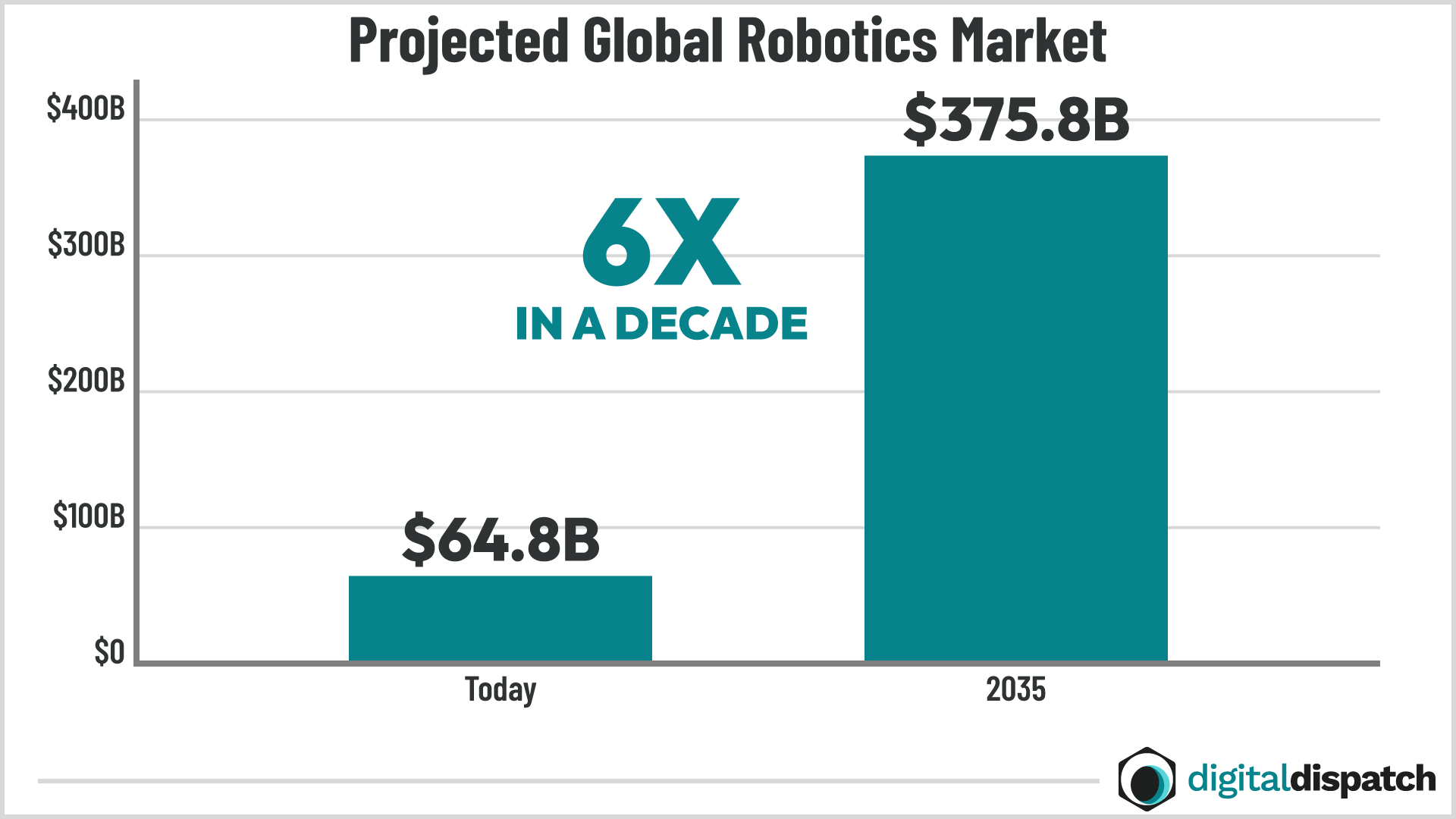
That makes robotics the most compelling investment narrative for the next decade.
Companies like Nvidia have already had their big run. The company is currently worth $5.6 trillion and has showered investors with massive returns. But right now the opportunities I'm most excited about are the smaller companies that are the building blocks of the AI revolution.
The picks-and-shovel companies that will rise regardless of what shape AI takes in the future.
In fact we’ve just completed a presentation unveiling Jensen Huang’s new “Nvidia Atlas Initiative” that explains everything.
And it has nothing to do with investing in Nvidia itself. The “Atlas Initiative" details three companies that span different segments of the robotics revolution.
Company number one is the "pure-play bet" on autonomous delivery. It’s a small-cap with explosive revenue growth and a strategic partnership with a household-name platform you are already using.
Company number two is a global software leader positioned to integrate physical robots with existing business systems. Right now the stock is trading at a steep discount to its true value, which is a prime buying opportunity.
Company number three is an automated warehouse play with a $22 billion contracted backlog from the world's largest retailers. They’re working behind the scenes to engineer massive breakthroughs in the retail space.
Each company attacks the AI robotics opportunity from a different angle.
Together, they create a diversified portfolio positioned to profit regardless of which specific robotics segment grows fastest.
The recent AI summit signaled a green light for aggressive growth, massive infrastructure expansion, and a hands-off approach to federal regulation.
It’s the clearest signal yet that these three companies are now off to the races…
Godspeed,

Jimmy Mengel
Director of Customer Experience, Bizarro World