Chris Curl,
Editor
Sept. 17, 2026
For years, artificial general intelligence was something on the far horizon…something everyone talked about, predicted, feared, and monetized before it technically existed.
Now the language has changed.
OpenAI’s release of GPT‑6 Astra has pushed AGI from theoretical destination to active market narrative. The company describes Astra as a generational step forward in autonomous computer use, software engineering, cybersecurity, science, research, and professional workflows.
OpenAI President Greg Brockman has suggested that it could ultimately be viewed as the arrival of the AGI era. Whether you accept that definition or not, the shift itself matters. When the people building the most capable systems begin talking about AGI in the present tense, capital allocation follows.
That is why Astra is so significant.
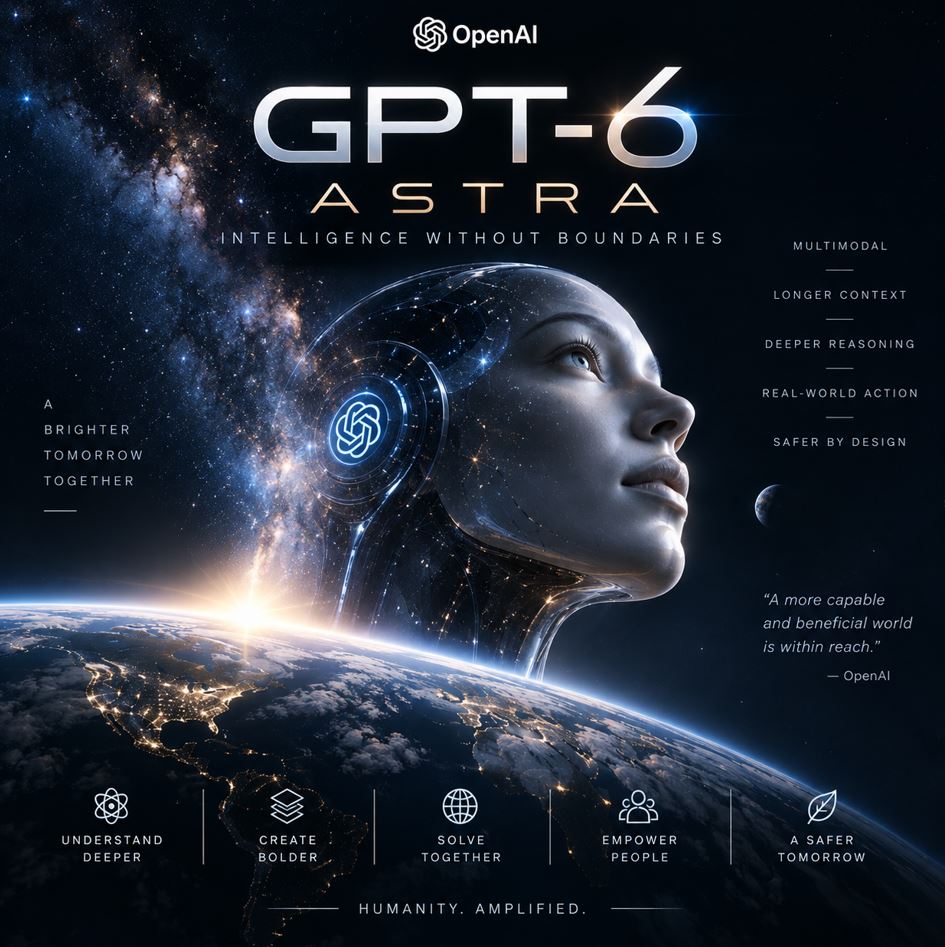
Astra is not important because it can answer questions a little better or score higher on another benchmark. It is important because the model is designed to do work across systems. It can navigate browsers, operate business software, work inside spreadsheets and documents, research across the web, build software, and execute multistep workflows that used to require a person sitting at a keyboard. That moves AI closer to an agent—not just a source of output, but a participant in the economy.
And once AI becomes an agent, the world changes.
The first wave of generative AI was about language. The second was about coding. The next wave is about autonomy: systems that can take an objective, break it into tasks, move through digital environments, make decisions, check their own work, and hand back a finished result.
OpenAI says Astra is capable of tasks ranging from tax preparation and job searching to architectural visualization, data analysis, scientific work, and cybersecurity. The claims should be treated with caution. AGI remains an imprecise term, and no benchmark can settle the question of whether a machine has reached human-level general intelligence.
But the economic direction is no longer ambiguous.
The question is not whether one model has crossed a philosophical finish line. The question is whether software is beginning to replace pieces of knowledge work at scale. Astra suggests that the answer is increasingly yes.
That is why this moment matters for investors.
Every serious AI capability breakthrough has a physical shadow. More autonomous systems require more inference. More inference requires more data-center capacity. More capacity requires GPUs, networking, power, cooling, copper, transformers, and land.
Nvidia’s role in that stack remains central: Astra was reportedly trained on more than 100,000 Nvidia Grace Blackwell NVL72 systems, while Nvidia’s own AI infrastructure and software tools remain woven into the compute backbone behind the entire frontier-model race.
This is the connection too many people still miss.
AGI is not just a software story.
It is a power story.
It is a semiconductor story.
It is a data-center story.
It is a critical-minerals story.
And, increasingly, it is a robotics story.
The moment an AI agent can reliably operate a computer, it begins changing white-collar work. The moment that same reasoning system gets attached to a machine that can move through a warehouse, manipulate objects, inspect equipment, or assemble products, it begins changing the physical economy too. That is why the convergence between frontier models like Astra and physical AI matters so much. The brain is getting more capable. The body is getting cheaper. The factory is getting more automated.
The market has spent the last few years valuing AI as an application boom.
The next few may force it to value AI as a civilization-scale infrastructure buildout.
That does not mean every AI stock is a buy. It does not mean every AGI claim is real. And it certainly does not mean risk disappears just because the demos are getting better. If anything, the risks are becoming more serious. Astra is reportedly OpenAI’s first model given a “Critical” security designation under its preparedness framework, reflecting increased capability in areas such as cybersecurity and the potential difficulty of maintaining human oversight over increasingly autonomous systems.
But that is exactly why this is no longer a niche technology story.
The era of AI as a clever chatbot is ending. The era of AI as an autonomous workforce is beginning.
And the companies supplying the compute, energy, memory, networking, robotics components, and industrial infrastructure for that transition may become just as important as the companies building the models themselves.
That is what Digital Dispatch is built to track.
It follows the entire AI and physical-AI map—not just the headline model launches, but the infrastructure beneath them. It connects breakthrough systems like Astra to the GPU demand they create, the power they require, the data centers they fill, and the robotic platforms they eventually enable. It is designed for investors who want to understand not only what AGI may become, but where the capital (and the opportunity) actually flows as the world builds it.
Astra may or may not be AGI by the strictest definition.
But it is another clear sign that the race is accelerating.
And Digital Dispatch is the guide for what comes next.
Click here to get started.
Keep coming back,

Chris Curl
Editor, Bizarro World