Chris Curl,
Editor
Oct. 29, 2026

It is not another meme coin.
It is not a new trading app.
It is tokenization… and I believe it will become one of the biggest investment trends of the next decade. If not THE biggest.
While traders obsess over Bitcoin’s latest pullback, the institutions that manage enormous pools of capital are focused on a different question:
What happens when stocks, bonds, funds, and other financial assets move onto blockchain-based infrastructure?
BlackRock’s Larry Fink has called tokenization the next generation for markets. Alongside COO Rob Goldstein, he has described it as a major evolution in financial infrastructure…
One that could make investments easier to issue, move, and access.
That is a much bigger story than whether Bitcoin has a good week.

And in my latest issue of Crypto Cycle, I explain why one cryptocurrency has become my preferred speculative way to play it.
Not because owning the token means owning Wall Street’s assets.
It does not.
But because the platform associated with it is building directly into the market Wall Street wants to create.
Don’t Confuse a Pullback With the End of the Bull
Before we get to tokenization, let’s address the concern hanging over the digital-asset market.
Prices pulled back. Leverage got flushed. Traders who were enthusiastic at higher prices suddenly became nervous at lower ones.
My view remains the same: Bitcoin and the broader digital-asset market are in a bull market. That does not mean every coin will rise, or that the next move must be higher.
In my latest issue, I laid out the technical foundation for that view. Bitcoin had broken through the $80,000-$83,000 resistance band, then returned to test it. Rather than immediately collapsing back into its old range, it was holding the area that previously capped the rally.
Former resistance becoming support is very significant. A market consolidating after a breakout is not the same as a market breaking down.
There is an invalidation point, too. As I wrote in the issue, a sustained move below $80,000 followed by failed attempts to reclaim the band would make me reassess.
But I am not going to abandon a bullish framework simply because the market stopped moving in a straight line.
Especially when the underlying financial infrastructure is moving in precisely the direction crypto investors have anticipated for years.
Wall Street Wants the Technology
For a long time, the argument was that crypto would replace Wall Street.
The more interesting (and likely) possibility is that Wall Street adopts the infrastructure.
Tokenization means recording ownership of (or a legally structured claim on) an asset through a digital token on a blockchain. The underlying investment might still be a Treasury instrument, a fund, or a stock. What changes is how that exposure is recorded, transferred, and used.
Think of it as upgrading the financial system’s plumbing.
The potential benefits include faster settlement, fewer manual reconciliation processes, and more flexible ways to distribute investments. Depending on the product and its legal structure, tokenized assets could also become easier to transfer or use as collateral.
The important word is “potential.” A blockchain does not eliminate securities laws, investor restrictions, custody requirements, or counterparty risk.
But those obstacles do not make the opportunity less significant. They explain why building the right infrastructure matters.
BlackRock’s ambition goes well beyond letting investors buy Bitcoin through an ETF. Fink has described digital wallets holding a broader range of investments, including tokenized bonds, ETFs, and interests in private assets.
The investment universe does not have to be reinvented for this to be transformative.
Its distribution system does.
Why This Could Be the Next Financial Megatrend
Most crypto narratives depend on attracting more people into crypto.
Tokenization has a different source of potential demand: assets and investors that already exist.
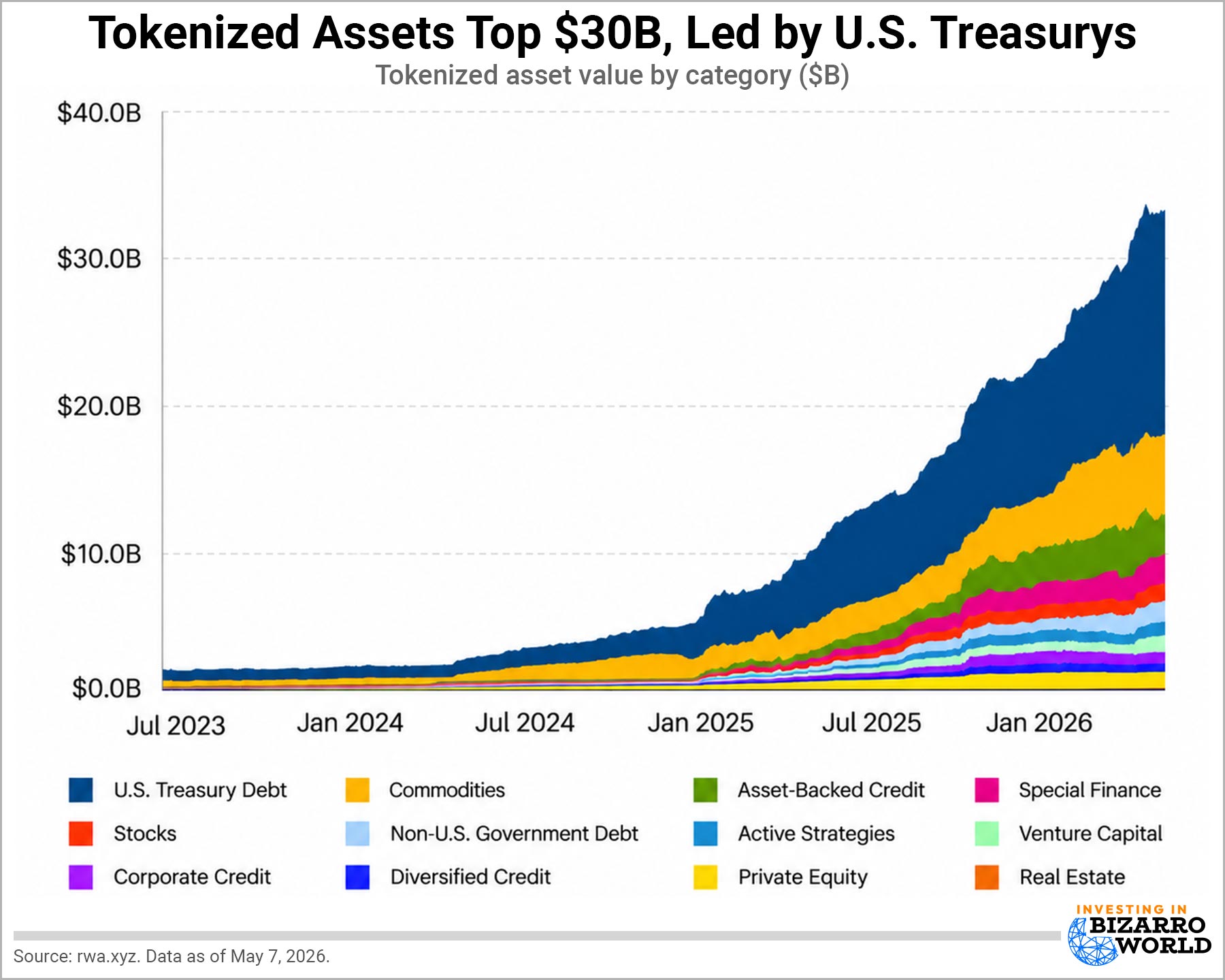
Governments already issue debt. Companies already sell shares. Asset managers already run funds. Investors already need ways to hold, transfer, and finance those positions.
If blockchain infrastructure performs some of those functions more efficiently, adoption does not have to depend entirely on enthusiasm for cryptocurrency.
It can depend on economics.
That is why I take this trend seriously. It has a use case beyond speculation with major institutions building toward it.
I follow BlackRock’s roadmap from tokenized money-market products toward a wider universe of funds and private-market investments. I also examine the next step: making tokenized assets useful as collateral beyond crypto-native markets.
Issuing a token is one thing.
Making that token useful throughout the financial system is where the larger opportunity begins.
The Cryptocurrency I’m Watching
Buying BlackRock (NYSE: BLK) shares is one way to gain exposure to the institutions pursuing this transition.
But I am also interested in a smaller, more speculative opportunity: a cryptocurrency associated with a platform bringing traditional financial assets onchain.
The attraction is its combination of existing products and a much larger ambition.
As detailed in my latest issue, the platform has established a presence in tokenized Treasury exposure and is pursuing broader securities distribution. Its private-markets push adds another potential growth avenue, although access remains subject to jurisdiction and investor eligibility.
That combination is what sets it apart in my research.
It is not simply promising to build something if tokenization becomes popular. It already has an operating platform in a sector that major financial institutions are actively developing.
Following the Infrastructure
A market pullback can dominate the conversation for days.
A change in financial infrastructure can shape investment opportunities for years.
My bullish view of the digital-asset cycle provides the backdrop. Tokenization provides a longer-term reason to pay attention. And this particular cryptocurrency offers a speculative way to position for that convergence.
That is why I added it to the Crypto Cycle portfolio.
In the latest issue, I explain the project, the purchase, the competitive landscape, and the value-capture question that could determine whether platform growth ever becomes meaningful value for holders.
Join Crypto Cycle for the full recommendation and the portfolio strategy behind it.
Wall Street is working on bringing more of traditional finance onchain.
Make sure you’re invested in that transition.
Click here to get started.
Keep coming back,

Chris Curl
Editor, Bizarro World