Chris Curl,
Editor
Oct. 1, 2026
For the last three years, the AI trade has felt almost frictionless.
Buy the chips. Buy the cloud. Buy the data centers. Buy the power providers. Buy the cooling companies. Buy anything remotely connected to “AI,” then assume the numbers will take care of themselves.
That story has worked—spectacularly.
But the leaked Anthropic IPO filing is a reminder that every boom eventually reaches the point where investors stop asking only how fast revenue is growing and start asking what it costs to produce that growth.
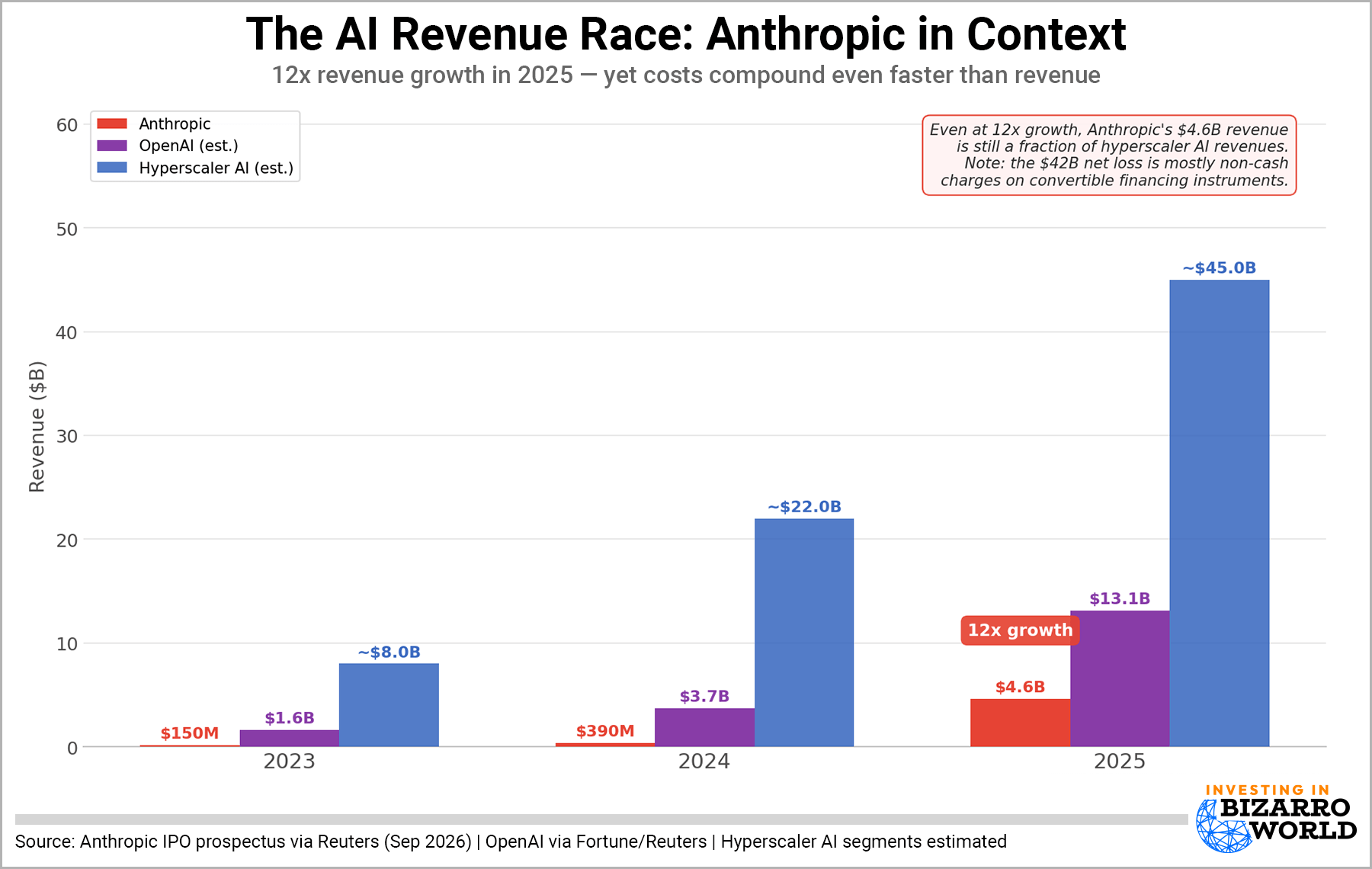
The figures are staggering. Anthropic reportedly expanded revenue roughly twelvefold in 2025 to nearly $4.6 billion, yet also posted a $42 billion net loss, more than $8 billion in operating losses before financing-related accounting charges, and roughly $7.3 billion in compute and infrastructure spending. Looking ahead, the company reportedly has about $518 billion in cloud, compute, and infrastructure commitments.
That is not evidence that AI is fake.
It is evidence that AI is expensive.
And there is a difference.
The frontier-model race requires vast amounts of specialized compute, data-center capacity, power, networking, engineering talent, training, inference, and constant model upgrades. Every time one lab ships a more capable model, every other serious lab has to respond—or risk falling behind. The result is a capital cycle that can accelerate even as returns on that capital become harder to prove.
That is the bill coming due.
The Trade Isn’t Finished
The easy conclusion would be that the AI trade is over.
It is not.
AI is still changing software, search, coding, research, customer service, design, automation, and eventually the physical world through robotics. The long-term transformation remains real. The companies providing compute, networking, power, cooling, and data-center infrastructure are not building castles in the air. They are supplying a genuine industrial buildout.
But a genuine long-term trend can still become a crowded short-term trade.
That is the distinction investors need to understand.
Anthropic’s filing does not say demand is disappearing. It says the path from demand to durable profits is going to be more complicated than the market wanted to believe. Revenue can compound rapidly while costs compound even faster. A model can be impressive while still being expensive to train and expensive to serve. Hyperscalers can report booming AI demand while spending so aggressively that investors begin asking when all that capital expenditure earns an acceptable return.
The market does not need AI to fail for AI stocks to fall.
It only needs growth to be slightly less perfect than expectations.
A Different Phase of the Cycle
The first phase of an infrastructure boom rewards nearly everything connected to the story. Investors see the demand wave coming and bid up the chipmakers, the networking names, the power suppliers, the data-center builders, the cooling companies, and the broad thematic ETFs.
The second phase is more selective.
That is when the market starts differentiating between the companies that can convert AI spending into durable returns and the companies that merely benefited from the first blast of capital expenditure. It is also when the market begins to worry about capacity digestion: customers pausing to measure returns, projects being delayed, cloud providers optimizing existing infrastructure, and valuations resetting when “extraordinary” becomes merely “very good.”
That is where we may be heading into Q4.
The best AI infrastructure businesses can remain great businesses. The question is whether their stocks have already priced in too many years of flawless spending growth. Digital Dispatch is watching that risk closely and looking for opportunities to manage exposure in direct AI-capex beneficiaries if the market gives us another euphoric leg higher.
This is not a call to abandon AI.
It is a call to separate the technology thesis from the trade thesis.
The Opportunity Moves Elsewhere
One of the advantages of taking profits into strength is that it creates flexibility.
If the direct AI trade experiences a reset, capital can be held for better entries. It can be redeployed into less crowded areas of the buildout. Or it can move toward themes that are earlier in their own cycle: crypto infrastructure, tokenization, robotics, critical resources, and the power systems needed to support the next generation of computing.
That is the framework behind Digital Dispatch.
We are not here to marry a narrative at the exact moment everyone else has already fallen in love with it. We are here to follow the capital cycle, recognize when a powerful theme is becoming expensive, and look for the second-order opportunities that still have room to run.
The AI bill is coming due.
That does not mean the AI trade is finished.
It means the easy part may be.
Digital Dispatch subscribers have already banked multiple triple-digit gains during this AI buildout with many more to come.
If you want to see what picks are in the portfolio simply click here to get started.
Keep coming back,

Chris Curl
Editor, Bizarro World